analyzing projectile motion represented by a table\nthe table relates to a function h(t) that models the…
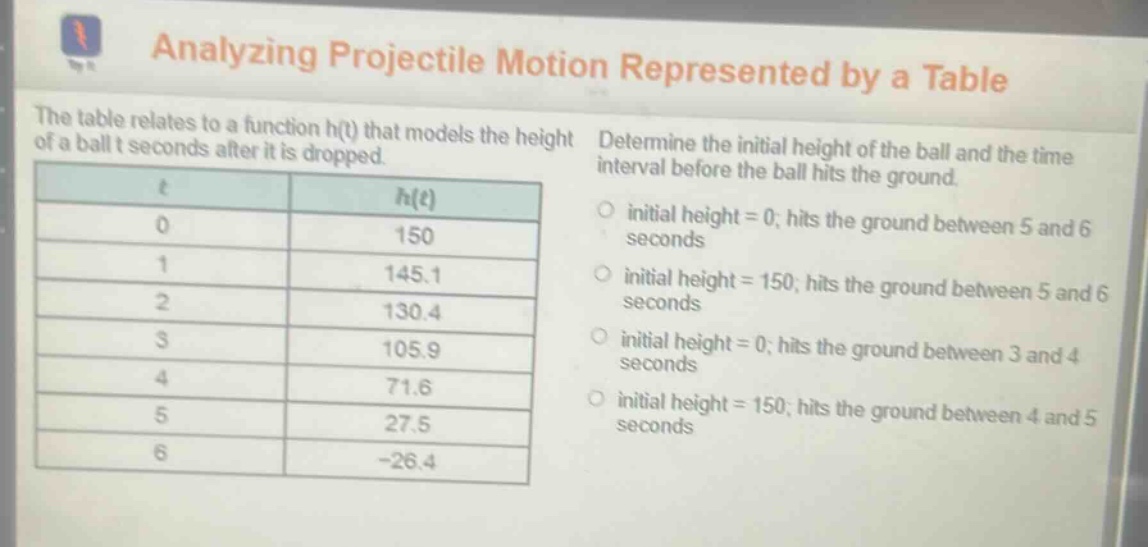
analyzing projectile motion represented by a table\nthe table relates to a function h(t) that models the height of a ball t seconds after it is dropped. determine the initial height of the ball and the time interval before the ball hits the ground.\n| t | h(t) |\n|----|----|\n| 0 | 150 |\n| 1 | 145.1 |\n| 2 | 130.4 |\n| 3 | 105.9 |\n| 4 | 71.6 |\n| 5 | 27.5 |\n| 6 | -26.4 |\ninitial height = 0; hits the ground between 5 and 6 seconds\ninitial height = 150; hits the ground between 5 and 6 seconds\ninitial height = 0; hits the ground between 3 and 4 seconds\ninitial height = 150; hits the ground between 4 and 5 seconds
Answer
Explanation:
Step1: Find initial height
The initial height is when (t = 0). From the table, when (t=0), (h(0)=150).
Step2: Determine time of hitting ground
The ball hits the ground when (h(t)=0). The height is positive at (t = 5) ((h(5)=27.5)) and negative at (t = 6) ((h(6)=- 26.4)). So it hits the ground between (5) and (6) seconds.
Answer:
initial height = 150; hits the ground between 5 and 6 seconds