analyzing projectile motion\nthe table represents the height in meters of a baseball a pitcher threw to…
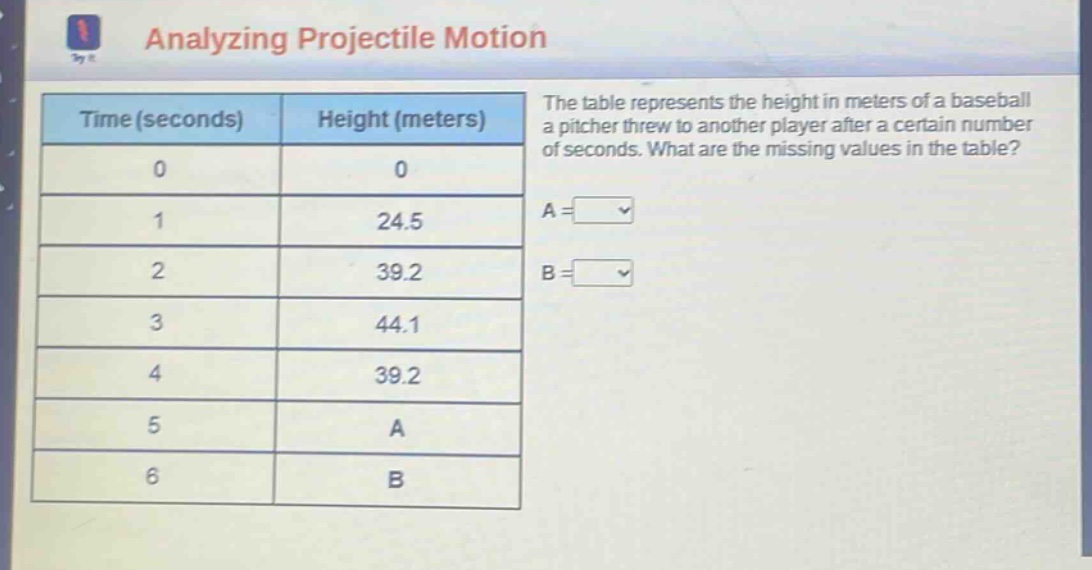
analyzing projectile motion\nthe table represents the height in meters of a baseball a pitcher threw to another player after a certain number of seconds. what are the missing values in the table?\ntime (seconds) height (meters)\n0 0\n1 24.5\n2 39.2\n3 44.1\n4 39.2\n5 a\n6 b
Answer
Explanation:
Step1: Identify the motion formula
The height - time relationship for vertical motion under gravity is $h = v_0t-\frac{1}{2}gt^2$. We can also use the symmetry of projectile motion. The motion of the baseball is symmetric about the vertex of its parabolic path. The vertex occurs at $t = 3$ (since the height values start to decrease after $t = 3$).
Step2: Use symmetry for $A$
The time $t = 5$ is symmetric to $t = 1$ about $t = 3$. So, the height at $t = 5$ is the same as the height at $t = 1$. So $A=24.5$.
Step3: Use symmetry for $B$
The time $t = 6$ is symmetric to $t = 0$ about $t = 3$. So, the height at $t = 6$ is the same as the height at $t = 0$. So $B = 0$.
Answer:
$A = 24.5$ $B = 0$