another property of longitudinal waves is frequency. just as in transverse waves, frequency is the number of…
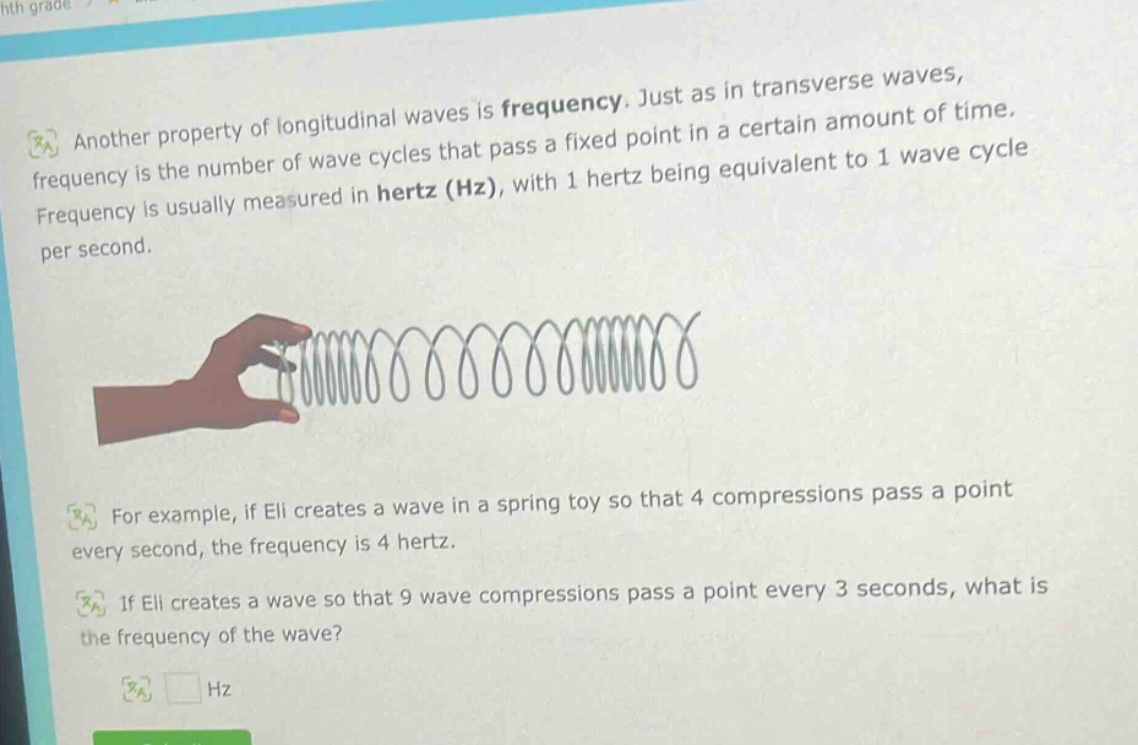
another property of longitudinal waves is frequency. just as in transverse waves, frequency is the number of wave cycles that pass a fixed point in a certain amount of time. frequency is usually measured in hertz (hz), with 1 hertz being equivalent to 1 wave cycle per second. for example, if eli creates a wave in a spring toy so that 4 compressions pass a point every second, the frequency is 4 hertz. if eli creates a wave so that 9 wave compressions pass a point every 3 seconds, what is the frequency of the wave? hz
Answer
Answer:
3 Hz
Explanation:
Step1: Recall frequency formula
Frequency = $\frac{\text{Number of cycles}}{\text{Time}}$
Step2: Identify values
Number of cycles = 9, Time = 3 s
Step3: Calculate frequency
Frequency = $\frac{9}{3}=3$ Hz