which answer choice represents a balanced alpha emission nuclear equation?\n$_{26}^{52}fe\\longrightarrow_{25…
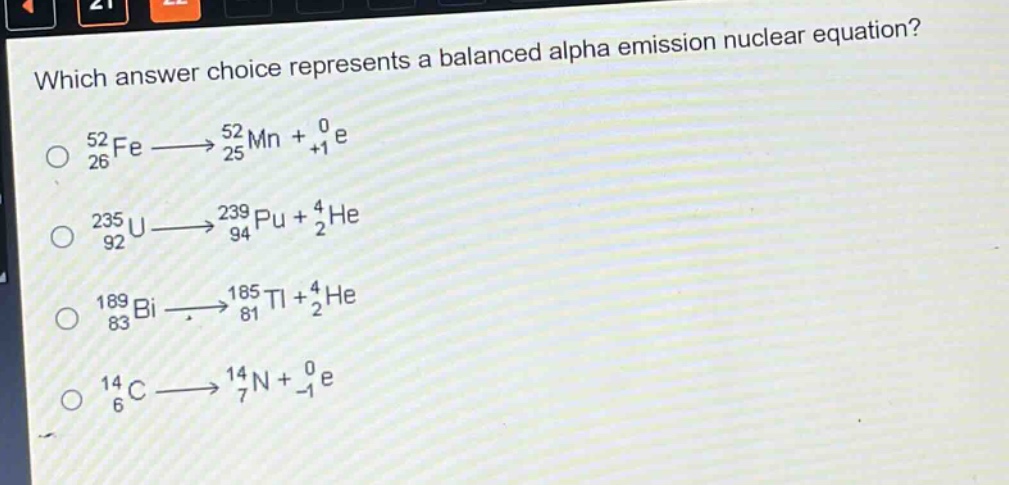
which answer choice represents a balanced alpha emission nuclear equation?\n$_{26}^{52}fe\\longrightarrow_{25}^{52}mn + _{+1}^{0}e$\n$_{92}^{235}u\\longrightarrow_{94}^{239}pu + _{2}^{4}he$\n$_{83}^{189}bi\\longrightarrow_{81}^{185}tl + _{2}^{4}he$\n$_{6}^{14}c\\longrightarrow_{7}^{14}n + _{-1}^{0}e$
Answer
Explanation:
Step1: Recall alpha - particle composition
An alpha - particle is represented as $_{2}^{4}He$. In alpha - emission, the mass number of the parent nucleus decreases by 4 and the atomic number decreases by 2.
Step2: Analyze each option
- Option 1: ${26}^{52}Fe\rightarrow{25}^{52}Mn + {+ 1}^{0}e$ is a beta - plus decay (positron emission) as it emits a positron (${+1}^{0}e$), not alpha - emission.
- Option 2: ${92}^{235}U\rightarrow{94}^{239}Pu+_{2}^{4}He$. Here, the mass number of uranium ($U$) is 235 and it is supposed to decrease by 4 in alpha - emission, but it increases to 239 for plutonium ($Pu$), so this is incorrect.
- Option 3: ${83}^{189}Bi\rightarrow{81}^{185}Tl + {2}^{4}He$. The mass number of bismuth ($Bi$) is 189. After emitting an alpha - particle (${2}^{4}He$), the new mass number is $189 - 4=185$ and the new atomic number is $83 - 2 = 81$, which corresponds to thallium ($Tl$). This is a balanced alpha - emission nuclear equation.
- Option 4: ${6}^{14}C\rightarrow{7}^{14}N+{ - 1}^{0}e$ is a beta - minus decay as it emits an electron (${-1}^{0}e$), not alpha - emission.
Answer:
${83}^{189}Bi\rightarrow{81}^{185}Tl + _{2}^{4}He$ (the third option)