if an answer for coulombs law is negative, it must mean the charges are opposite.\n(1 point)\ntrue\nfalse
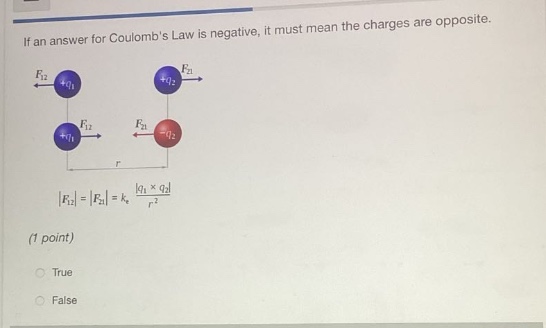
if an answer for coulombs law is negative, it must mean the charges are opposite.\n(1 point)\ntrue\nfalse
Answer
Explanation:
Step1: Recall Coulomb's Law
Coulomb's Law is $F = k_e\frac{q_1q_2}{r^2}$, where $F$ is the electrostatic - force between two charges $q_1$ and $q_2$, $k_e$ is the electrostatic constant, and $r$ is the distance between the charges. The sign of $F$ depends on the product $q_1q_2$.
Step2: Analyze the sign of the force
If $q_1$ and $q_2$ have the same sign (both positive or both negative), then $q_1q_2>0$ and the force is positive, indicating a repulsive force. If $q_1$ and $q_2$ have opposite signs (one positive and one negative), then $q_1q_2 < 0$ and the force is negative, indicating an attractive force.
Answer:
True