answer all of the questions below about either distance - time graph regarding the movement of an unknown…
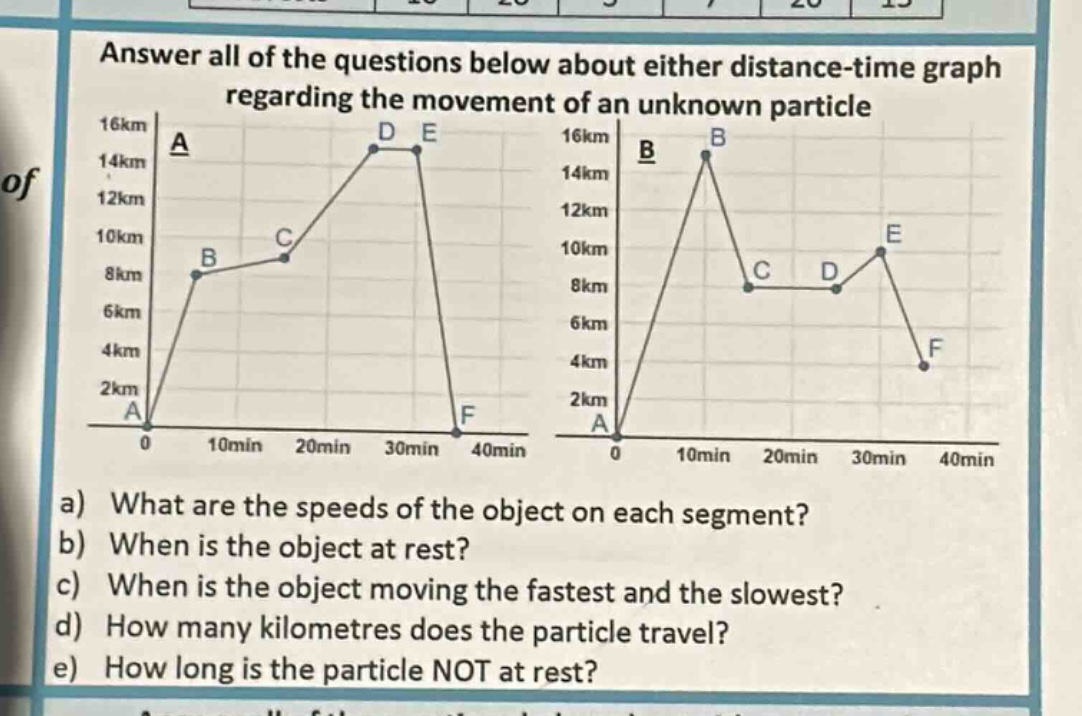
answer all of the questions below about either distance - time graph regarding the movement of an unknown particle\n\na) what are the speeds of the object on each segment?\nb) when is the object at rest?\nc) when is the object moving the fastest and the slowest?\nd) how many kilometres does the particle travel?\ne) how long is the particle not at rest?
Answer
Explanation:
Step1: Recall speed formula
Speed $v=\frac{\Delta d}{\Delta t}$, where $\Delta d$ is change in distance and $\Delta t$ is change in time.
Step2: Analyze graph A - segment AB
For segment AB in graph A, $\Delta d = 8 - 0=8$ km, $\Delta t=10 - 0 = 10$ min. So $v_{AB}=\frac{8}{10}=0.8$ km/min.
Step3: Analyze graph A - segment BC
For segment BC in graph A, $\Delta d = 9 - 8 = 1$ km, $\Delta t=20 - 10=10$ min. So $v_{BC}=\frac{1}{10}=0.1$ km/min.
Step4: Analyze graph A - segment CD
For segment CD in graph A, $\Delta d = 15 - 9=6$ km, $\Delta t=25 - 20 = 5$ min. So $v_{CD}=\frac{6}{5}=1.2$ km/min.
Step5: Analyze graph A - segment DE
For segment DE in graph A, $\Delta d = 15 - 15 = 0$ km, $\Delta t=30 - 25=5$ min. So $v_{DE}=0$ km/min.
Step6: Analyze graph A - segment EF
For segment EF in graph A, $\Delta d = 0 - 15=- 15$ km, $\Delta t=40 - 30 = 10$ min. So $v_{EF}=\frac{-15}{10}=-1.5$ km/min (speed magnitude is 1.5 km/min).
Step7: Analyze graph B - segments
Similarly for graph B, for AB: $\Delta d = 15 - 0 = 15$ km, $\Delta t=10 - 0=10$ min, $v_{AB}=1.5$ km/min; for BC: $\Delta d = 8 - 15=-7$ km, $\Delta t=15 - 10 = 5$ min, $v_{BC}=\frac{-7}{5}=-1.4$ km/min (magnitude 1.4 km/min); for CD: $\Delta d = 8 - 8 = 0$ km, $\Delta t=25 - 15 = 10$ min, $v_{CD}=0$ km/min; for DE: $\Delta d = 11 - 8 = 3$ km, $\Delta t=30 - 25 = 5$ min, $v_{DE}=\frac{3}{5}=0.6$ km/min; for EF: $\Delta d = 4 - 11=-7$ km, $\Delta t=40 - 30 = 10$ min, $v_{EF}=\frac{-7}{10}=-0.7$ km/min (magnitude 0.7 km/min).
Step8: Find when object is at rest
Object is at rest when $\Delta d = 0$. In graph A, it is at rest in segment DE (25 - 30 min). In graph B, it is at rest in segment CD (15 - 25 min).
Step9: Find fastest and slowest
Fastest speed in graph A is in segment CD (1.2 km/min), slowest is in segment BC (0.1 km/min). In graph B, fastest is in segment AB (1.5 km/min), slowest is in segment DE (0.6 km/min).
Step10: Calculate total distance
In graph A, total distance is $8 + 1+6+0 + 15=30$ km. In graph B, total distance is $15+7 + 0+3+7=32$ km.
Step11: Calculate time not at rest
In graph A, time not at rest is $10 + 10+5+10 = 35$ min. In graph B, time not at rest is $10+5+5+10 = 30$ min.
Answer:
a) Graph A: $v_{AB}=0.8$ km/min, $v_{BC}=0.1$ km/min, $v_{CD}=1.2$ km/min, $v_{DE}=0$ km/min, $v_{EF}=1.5$ km/min; Graph B: $v_{AB}=1.5$ km/min, $v_{BC}=1.4$ km/min, $v_{CD}=0$ km/min, $v_{DE}=0.6$ km/min, $v_{EF}=0.7$ km/min b) Graph A: 25 - 30 min; Graph B: 15 - 25 min c) Graph A: Fastest - CD, Slowest - BC; Graph B: Fastest - AB, Slowest - DE d) Graph A: 30 km; Graph B: 32 km e) Graph A: 35 min; Graph B: 30 min