by what approximate factor is the intensity of an earthquake with magnitude 5.4 greater than an earthquake…
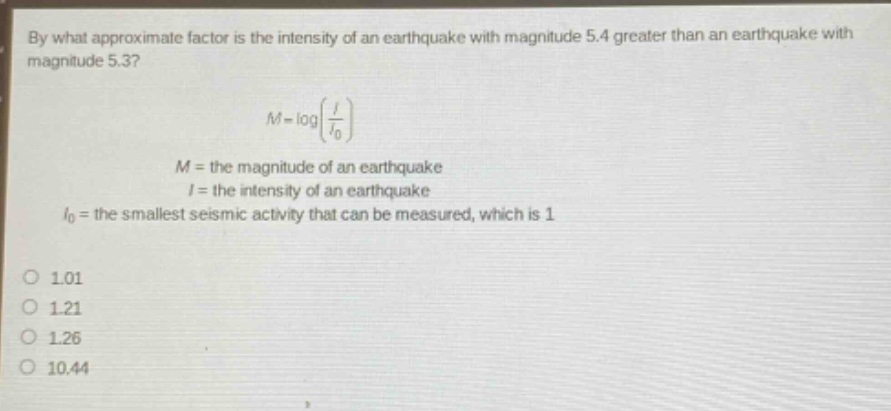
by what approximate factor is the intensity of an earthquake with magnitude 5.4 greater than an earthquake with magnitude 5.3?\nm = logleft(\frac{i}{i_0}\right)\n$m =$ the magnitude of an earthquake\n$i =$ the intensity of an earthquake\n$i_0 =$ the smallest seismic activity that can be measured, which is 1\n1.01\n1.21\n1.26\n10.44
Answer
Explanation:
Step1: Write equations for each magnitude
For magnitude $M_1 = 5.4$, we have $5.4=\log\left(\frac{I_1}{I_0}\right)$. Since $I_0 = 1$, then $5.4=\log(I_1)$, and by the definition of logarithm ($y = \log(x)$ means $x = 10^y$), $I_1=10^{5.4}$. For magnitude $M_2 = 5.3$, we have $5.3=\log\left(\frac{I_2}{I_0}\right)$. Since $I_0 = 1$, then $5.3=\log(I_2)$, and $I_2 = 10^{5.3}$.
Step2: Find the ratio of intensities
We want to find the factor by which $I_1$ is greater than $I_2$, so we calculate the ratio $\frac{I_1}{I_2}$. Substitute $I_1 = 10^{5.4}$ and $I_2=10^{5.3}$ into the ratio: $\frac{I_1}{I_2}=\frac{10^{5.4}}{10^{5.3}}$. According to the exponent - rule $\frac{a^m}{a^n}=a^{m - n}$, we have $\frac{10^{5.4}}{10^{5.3}}=10^{5.4 - 5.3}=10^{0.1}$.
Step3: Calculate the value of $10^{0.1}$
$10^{0.1}\approx1.26$.
Answer:
1.26