what is the approximate wavelength of a light whose first-order bright band forms a diffraction angle of…
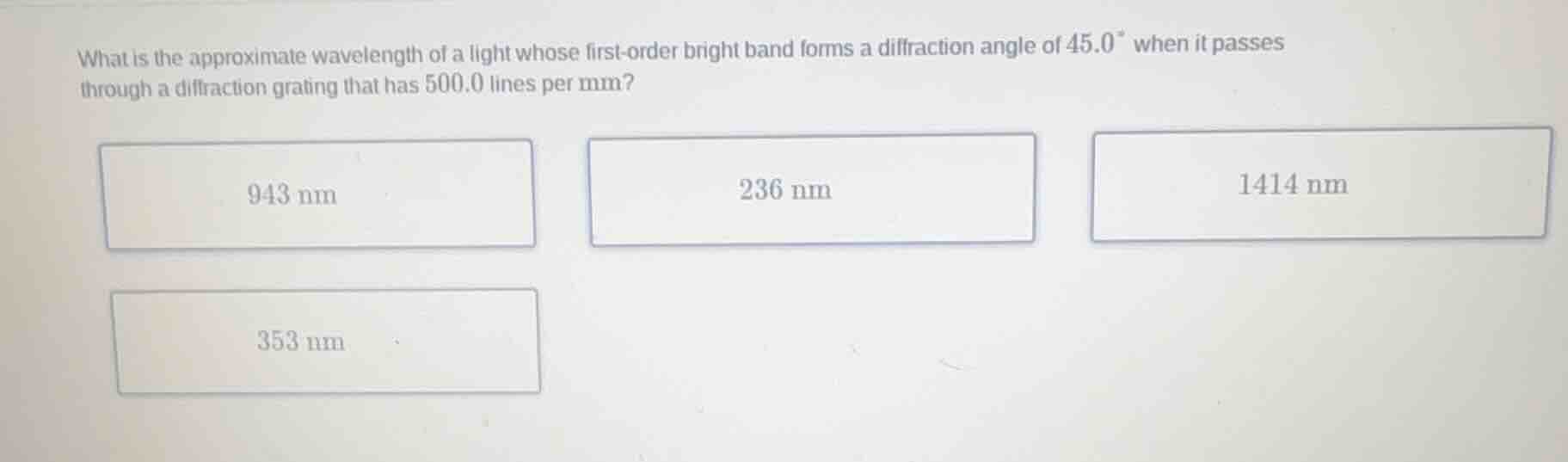
what is the approximate wavelength of a light whose first-order bright band forms a diffraction angle of $45.0^{\\circ}$ when it passes through a diffraction grating that has $500.0$ lines per mm?\n\n$943\\text{ nm}$\n$236\\text{ nm}$\n$1414\\text{ nm}$\n$353\\text{ nm}$
Answer
Explanation:
Step1: Calculate the grating spacing
The grating spacing $d$ is the reciprocal of the number of lines per unit length. $$d = \frac{1}{500.0 \text{ lines/mm}} = 0.002 \text{ mm} = 2000 \text{ nm}$$
Step2: Identify the diffraction grating formula
The formula for constructive interference in a diffraction grating is given by: $$d \sin(\theta) = m\lambda$$
Step3: Substitute known values into the formula
Given $m = 1$, $\theta = 45.0^{\circ}$, and $d = 2000 \text{ nm}$: $$2000 \text{ nm} \cdot \sin(45.0^{\circ}) = 1 \cdot \lambda$$
Step4: Solve for the wavelength
Calculate the value using $\sin(45.0^{\circ}) \approx 0.7071$. $$\lambda = 2000 \text{ nm} \cdot 0.7071 \approx 1414.2 \text{ nm}$$
Answer:
1414 nm