arch 207 (exam 1)\nsolve the following problems. write your final answer in the space provided. good…
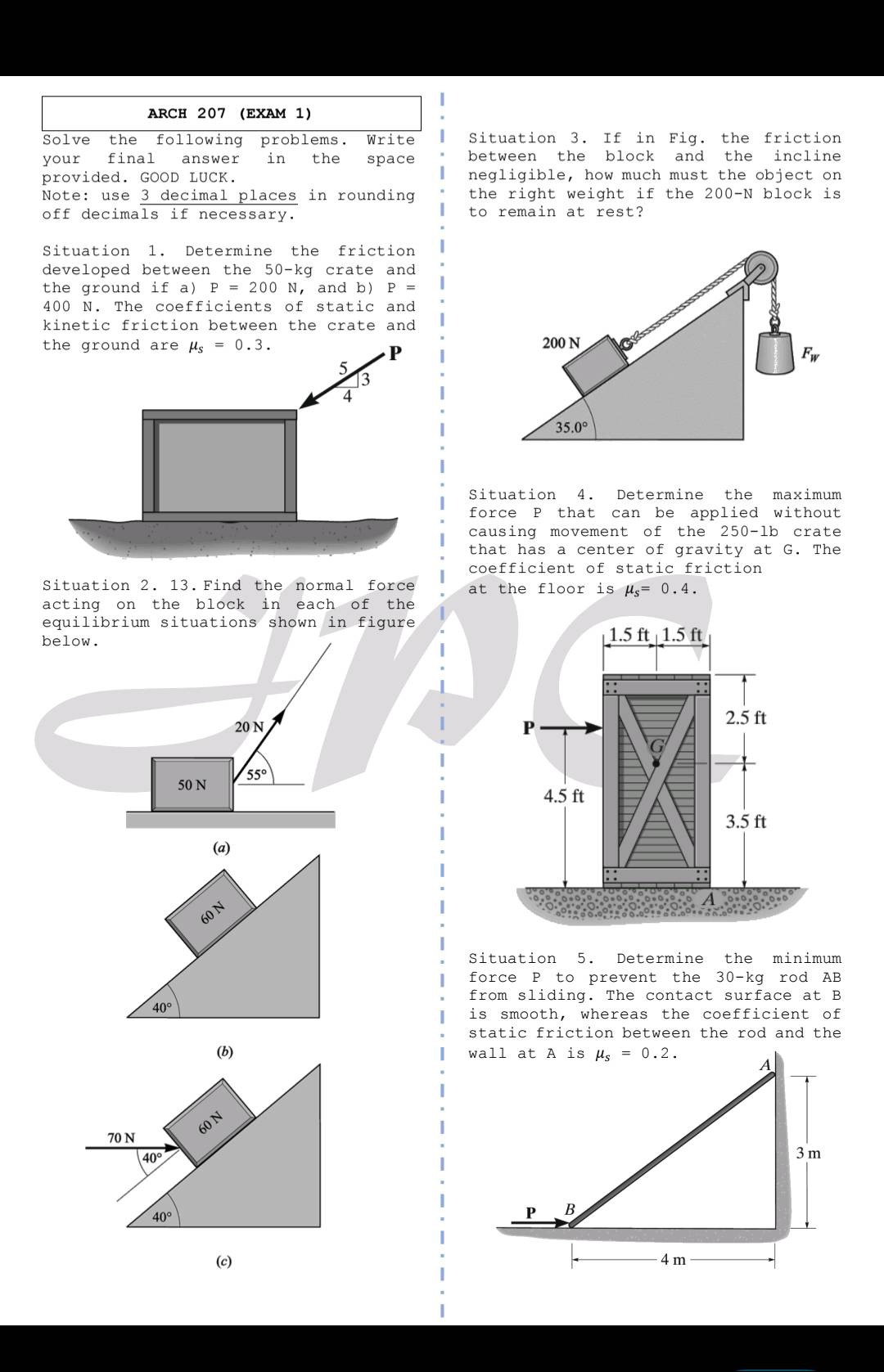
arch 207 (exam 1)\nsolve the following problems. write your final answer in the space provided. good luck.\nnote: use 3 decimal places in rounding off decimals if necessary.\nsituation 1. determine the friction developed between the 50 - kg crate and the ground if a) p = 200 n, and b) p = 400 n. the coefficients of static and kinetic friction between the crate and the ground are $mu_s = 0.3$.\nsituation 2. 13. find the normal force acting on the block in each of the equilibrium situations shown in figure below.\nsituation 3. if in fig. the friction between the block and the incline negligible, how much must the object on the right weight if the 200 - n block is to remain at rest?\nsituation 4. determine the maximum force p that can be applied without causing movement of the 250 - lb crate that has a center of gravity at g. the coefficient of static friction at the floor is $mu_s = 0.4$.\nsituation 5. determine the minimum force p to prevent the 30 - kg rod ab from sliding. the contact surface at b is smooth, whereas the coefficient of static friction between the rod and the wall at a is $mu_s = 0.2$.
Answer
Explanation:
Step1: Identify the problem type
This is a statics - friction and equilibrium problem in engineering mechanics.
Step2: Situation 1 - Calculate normal force on 50 - kg crate
The weight of the 50 - kg crate is $W =mg$, where $m = 50$ kg and $g=9.81$ m/s², so $W=50\times9.81 = 490.5$ N. The force $P$ has components. If $P$ is applied at an angle, assume $P$ has a horizontal component $P_x$ and a vertical component $P_y$. For a force $P$ with direction ratios 3 - 4 - 5, if $P = 200$ N, $P_x=\frac{4}{5}P = 160$ N and $P_y=\frac{3}{5}P = 120$ N. The normal force $N$ on the crate is $N=W - P_y=490.5-120 = 370.5$ N. The maximum static - friction force $F_{s,max}=\mu_sN=0.3\times370.5 = 111.15$ N. Since $P_x = 160$ N>$F_{s,max}$, the crate is moving and the kinetic - friction force $F_k=\mu_kN$. Assuming $\mu_k=\mu_s = 0.3$, $F_k = 0.3\times370.5=111.15$ N. When $P = 400$ N, $P_x=\frac{4}{5}\times400 = 320$ N and $P_y=\frac{3}{5}\times400 = 240$ N. The normal force $N=W - P_y=490.5 - 240=250.5$ N. The maximum static - friction force $F_{s,max}=\mu_sN=0.3\times250.5 = 75.15$ N. Since $P_x = 320$ N>$F_{s,max}$, the crate is moving and $F_k=\mu_kN=0.3\times250.5 = 75.15$ N.
Step3: Situation 2 - Calculate normal force
(a)
For the 50 - N block with a 20 - N force at 55°: The vertical component of the 20 - N force is $F_y = 20\sin55^{\circ}\approx16.383$ N. The normal force $N = 50 - 16.383=33.617$ N.
(b)
For the 60 - N block on a 40° incline: The normal force $N = 60\cos40^{\circ}\approx45.963$ N.
(c)
For the 60 - N block with a 70 - N force at 40° on a 40° incline: The normal - force component due to the weight is $N_1 = 60\cos40^{\circ}\approx45.963$ N. The vertical component of the 70 - N force is $F_y=70\sin40^{\circ}\approx44.995$ N. The normal force $N = 60\cos40^{\circ}+70\sin40^{\circ}\approx45.963 + 44.995=90.958$ N.
Step4: Situation 3 - Equilibrium on incline
For the 200 - N block on a 35.0° incline, the component of the 200 - N block's weight along the incline is $F_{parallel}=200\sin35.0^{\circ}\approx114.715$ N. For the block to remain at rest, the weight $F_W$ of the object on the right must balance this component, so $F_W = 114.715$ N.
Step5: Situation 4 - Maximum force without movement
The weight of the 250 - lb crate is $W = 250$ lb. The maximum static - friction force $F_{s,max}=\mu_sN$. The normal force $N = W=250$ lb. So $F_{s,max}=0.4\times250 = 100$ lb. The maximum force $P$ that can be applied without causing movement is equal to the maximum static - friction force, so $P = 100$ lb.
Step6: Situation 5 - Minimum force to prevent sliding
The weight of the 30 - kg rod $AB$ is $W=mg=30\times9.81 = 294.3$ N. Let's take moments about point $B$. The normal force at $A$ is $N_A$. The friction force at $A$ is $F_A=\mu_sN_A$. The length of the rod $L=\sqrt{3^{2}+4^{2}} = 5$ m. Taking moments about $B$: $W\times2 = N_A\times3+F_A\times4$. Since $F_A=\mu_sN_A = 0.2N_A$, we have $294.3\times2=N_A\times3 + 0.2N_A\times4$. $588.6=N_A(3 + 0.8)$. $N_A=\frac{588.6}{3.8}\approx154.895$ N. The minimum force $P = F_A=\mu_sN_A=0.2\times154.895 = 30.979$ N.
Answer:
Situation 1: a) $F = 111.150$ N, b) $F = 75.150$ N Situation 2: a) $N = 33.617$ N, b) $N = 45.963$ N, c) $N = 90.958$ N Situation 3: $F_W = 114.715$ N Situation 4: $P = 100$ lb Situation 5: $P = 30.979$ N