an arrow is fired at a target on a high wall. how does the energy change between the moment the arrow is…
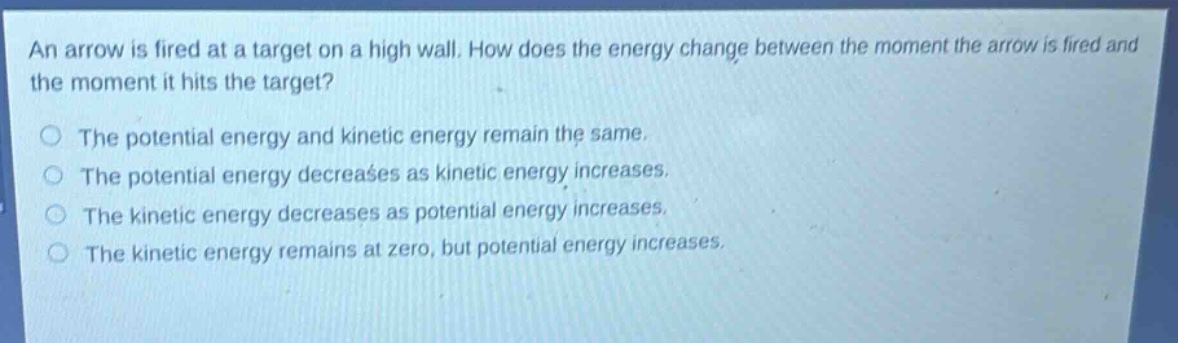
an arrow is fired at a target on a high wall. how does the energy change between the moment the arrow is fired and the moment it hits the target?\nthe potential energy and kinetic energy remain the same.\nthe potential energy decreases as kinetic energy increases.\nthe kinetic energy decreases as potential energy increases.\nthe kinetic energy remains at zero, but potential energy increases.
Answer
Brief Explanations:
When the arrow is fired, it has high kinetic energy and relatively low potential energy (assuming it starts from a lower - height position). As it moves up towards the high - wall target, its height increases. According to the conservation of mechanical energy (neglecting air resistance), the total mechanical energy (sum of kinetic and potential energy) remains constant. As the height of the arrow increases, its potential energy $U = mgh$ (where $m$ is mass, $g$ is gravitational acceleration, and $h$ is height) increases. Since the total energy is constant, the kinetic energy $K=\frac{1}{2}mv^{2}$ (where $v$ is velocity) must decrease.
Answer:
The kinetic energy decreases as potential energy increases.