an artificial satellite orbits earth at a speed of 7800 m/s and a height of 200 km above earths surface. the…
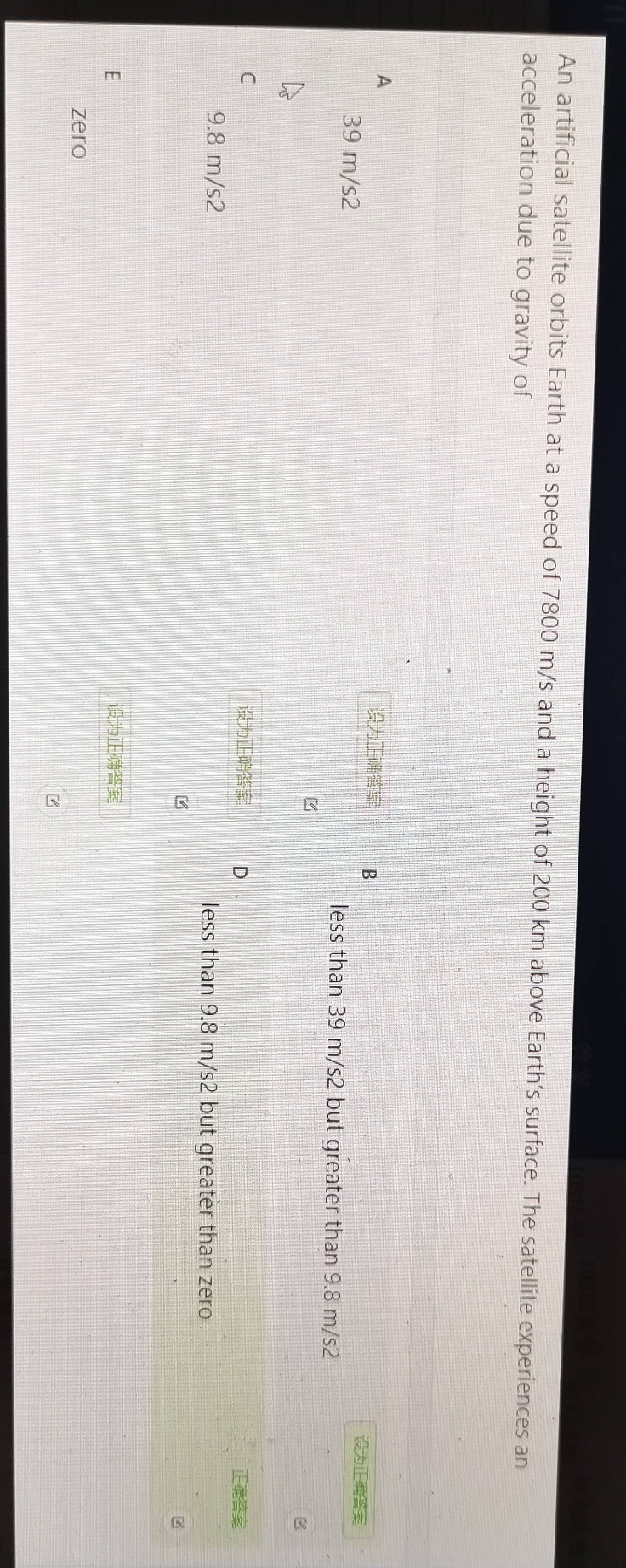
an artificial satellite orbits earth at a speed of 7800 m/s and a height of 200 km above earths surface. the satellite experiences an acceleration due to gravity of\na 39 m/s2\nb less than 39 m/s2 but greater than 9.8 m/s2\nc 9.8 m/s2\nd less than 9.8 m/s2 but greater than zero\ne zero
Answer
Explanation:
Step1: Recall gravitational - acceleration formula
The gravitational acceleration (g=\frac{GM}{r^{2}}), where (G) is the gravitational constant, (M) is the mass of the Earth, and (r) is the distance from the center of the Earth to the object. On the Earth's surface ((r = R_E)), (g_0=\frac{GM}{R_E^{2}}\approx9.8m/s^{2}). When the satellite is at a height (h = 200km) above the Earth's surface, (r=R_E + h).
Step2: Analyze the change of gravitational - acceleration
Since (g=\frac{GM}{(R_E + h)^{2}}) and (h>0), then (g<\frac{GM}{R_E^{2}}), so (g < 9.8m/s^{2}). And because there is still gravitational force acting on the satellite, (g>0).
Answer:
D. less than 9.8 m/s² but greater than zero