8. an astronaut on the moon throws a baseball upward with an initial velocity of 10 meters per second…
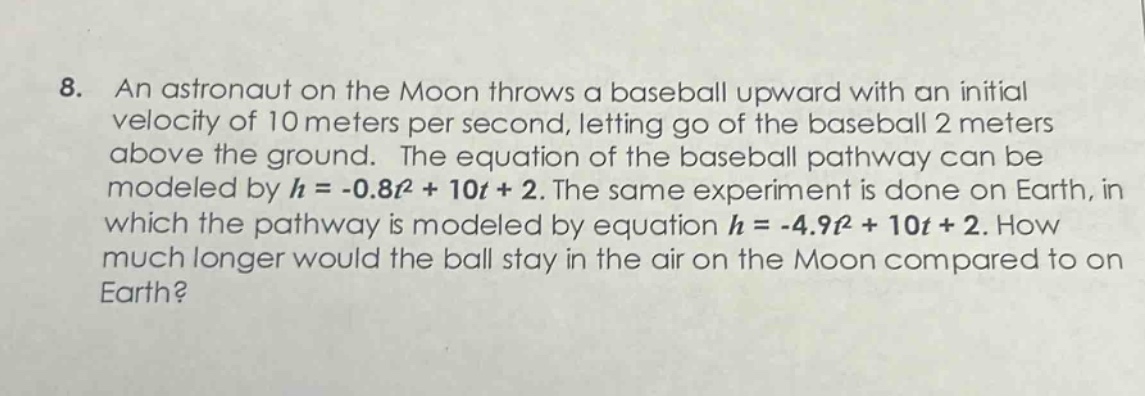
8. an astronaut on the moon throws a baseball upward with an initial velocity of 10 meters per second, letting go of the baseball 2 meters above the ground. the equation of the baseball pathway can be modeled by h = -0.8t² + 10t + 2. the same experiment is done on earth, in which the pathway is modeled by equation h = -4.9t² + 10t + 2. how much longer would the ball stay in the air on the moon compared to on earth?
Answer
Explanation:
Step1: Find time on Moon
Set $h = 0$ for the Moon - equation $0=-0.8t^{2}+10t + 2$. Use the quadratic formula $t=\frac{-b\pm\sqrt{b^{2}-4ac}}{2a}$ for the quadratic equation $ax^{2}+bx + c = 0$. Here, $a=-0.8$, $b = 10$, $c = 2$. $t_{M}=\frac{-10\pm\sqrt{10^{2}-4\times(-0.8)\times2}}{2\times(-0.8)}=\frac{-10\pm\sqrt{100 + 6.4}}{-1.6}=\frac{-10\pm\sqrt{106.4}}{-1.6}$. We take the positive root $t_{M}=\frac{-10+\sqrt{106.4}}{-1.6}\approx\frac{-10 + 10.31}{-1.6}=\frac{0.31}{-1.6}\text{(rejected)}$ or $t_{M}=\frac{-10 - 10.31}{-1.6}=\frac{-20.31}{-1.6}\approx12.69$ s.
Step2: Find time on Earth
Set $h = 0$ for the Earth - equation $0=-4.9t^{2}+10t + 2$. Using the quadratic formula with $a=-4.9$, $b = 10$, $c = 2$. $t_{E}=\frac{-10\pm\sqrt{10^{2}-4\times(-4.9)\times2}}{2\times(-4.9)}=\frac{-10\pm\sqrt{100 + 39.2}}{-9.8}=\frac{-10\pm\sqrt{139.2}}{-9.8}$. We take the positive root $t_{E}=\frac{-10+\sqrt{139.2}}{-9.8}\approx\frac{-10 + 11.8}{-9.8}=\frac{1.8}{-9.8}\text{(rejected)}$ or $t_{E}=\frac{-10 - 11.8}{-9.8}=\frac{-21.8}{-9.8}\approx2.22$ s.
Step3: Calculate the time - difference
$\Delta t=t_{M}-t_{E}\approx12.69 - 2.22=10.47$ s.
Answer:
$10.47$ s