an atomic physicist determines that an atom is composed of 8 positively - charged particles and has a mass…
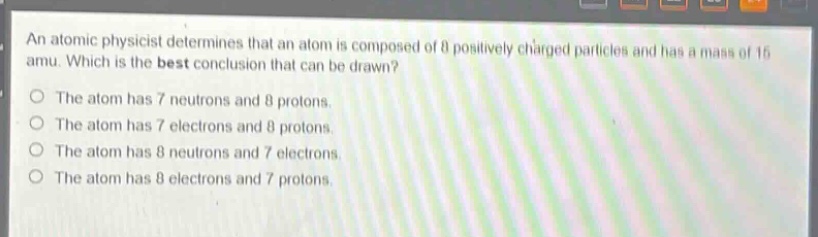
an atomic physicist determines that an atom is composed of 8 positively - charged particles and has a mass of 15 amu. which is the best conclusion that can be drawn?\nthe atom has 7 neutrons and 8 protons.\nthe atom has 7 electrons and 8 protons.\nthe atom has 8 neutrons and 7 electrons.\nthe atom has 8 electrons and 7 protons.
Answer
Answer:
A. The atom has 7 neutrons and 8 protons.
Explanation:
Step1: Recall proton - charge and number
Protons are positively charged. Given 8 positively - charged particles, so number of protons (p = 8).
Step2: Recall mass number formula
The mass number (A) of an atom is the sum of protons and neutrons ((A=p + n)). Given (A = 15) amu and (p = 8).
Step3: Calculate number of neutrons
We can find the number of neutrons (n) using the formula (n=A - p). Substituting (A = 15) and (p = 8), we get (n=15 - 8=7). Electrons are negatively charged and not considered in mass calculation here. So the atom has 7 neutrons and 8 protons.