atomic structure and coulombs law quiz retake\n1. which option correctly explains what makes two atoms…
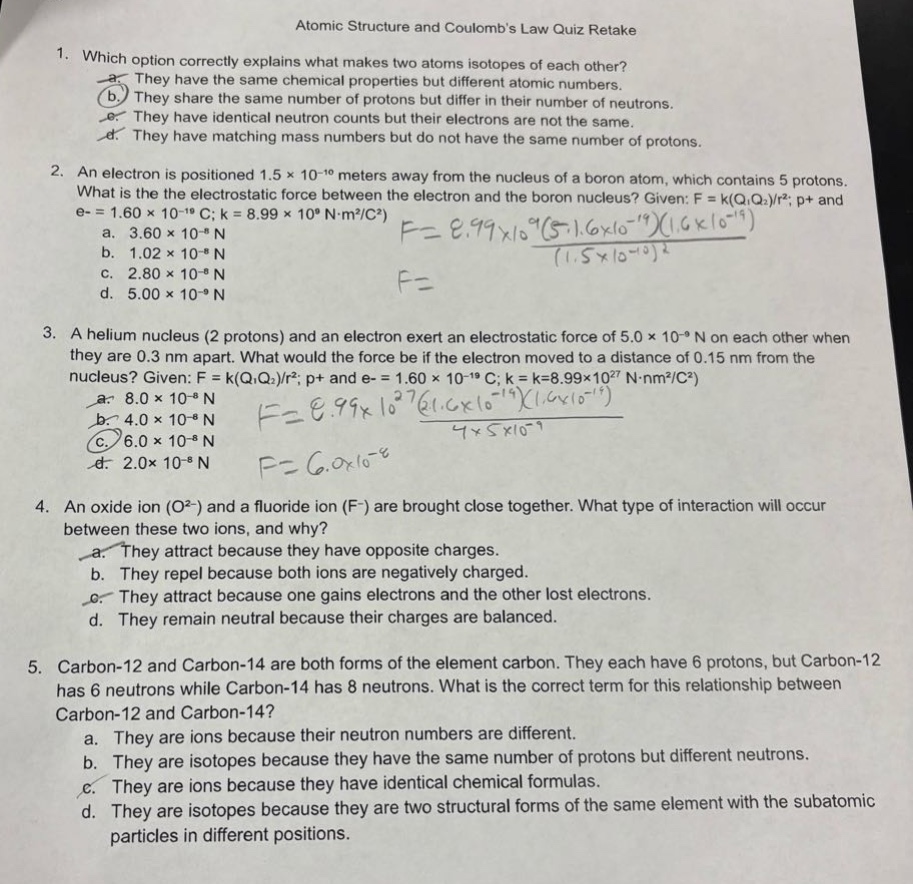
atomic structure and coulombs law quiz retake\n1. which option correctly explains what makes two atoms isotopes of each other?\na. they have the same chemical properties but different atomic numbers.\nb. they share the same number of protons but differ in their number of neutrons.\nc. they have identical neutron counts but their electrons are not the same.\nd. they have matching mass numbers but do not have the same number of protons.\n2. an electron is positioned 1.5×10⁻¹⁰ meters away from the nucleus of a boron atom, which contains 5 protons. what is the electrostatic force between the electron and the boron nucleus? given: f = k(q₁q₂)/r²; p+ and e- = 1.60×10⁻¹⁹ c; k = 8.99×10⁹ n·m²/c²)\na. 3.60×10⁻⁸ n\nb. 1.02×10⁻⁸ n\nc. 2.80×10⁻⁸ n\nd. 5.00×10⁻⁹ n\n3. a helium nucleus (2 protons) and an electron exert an electrostatic force of 5.0×10⁻⁹ n on each other when they are 0.3 nm apart. what would the force be if the electron moved to a distance of 0.15 nm from the nucleus? given: f = k(q₁q₂)/r²; p+ and e- = 1.60×10⁻¹⁹ c; k = 8.99×10²⁷ n·nm²/c²)\na. 8.0×10⁻⁸ n\nb. 4.0×10⁻⁸ n\nc. 6.0×10⁻⁸ n\nd. 2.0×10⁻⁸ n\n4. an oxide ion (o²⁻) and a fluoride ion (f⁻) are brought close together. what type of interaction will occur between these two ions, and why?\na. they attract because they have opposite charges.\nb. they repel because both ions are negatively charged.\nc. they attract because one gains electrons and the other lost electrons.\nd. they remain neutral because their charges are balanced.\n5. carbon - 12 and carbon - 14 are both forms of the element carbon. they each have 6 protons, but carbon - 12 has 6 neutrons while carbon - 14 has 8 neutrons. what is the correct term for this relationship between carbon - 12 and carbon - 14?\na. they are ions because their neutron numbers are different.\nb. they are isotopes because they have the same number of protons but different neutrons.\nc. they are ions because they have identical chemical formulas.\nd. they are isotopes because they are two structural forms of the same element with the subatomic particles in different positions.
Answer
Brief Explanations:
- Isotopes have the same number of protons but different numbers of neutrons. Option b is correct as it accurately describes this property.
- Use Coulomb's law $F = k\frac{Q_1Q_2}{r^2}$. Here, $Q_1$ (charge of electron) $=- 1.60\times10^{-19}\ C$, $Q_2$ (charge of boron nucleus with 5 protons) $=5\times1.60\times10^{-19}\ C$, $r = 1.5\times10^{-10}\ m$ and $k = 8.99\times10^{9}\ N\cdot m^{2}/C^{2}$. Substituting values: [ \begin{align*} F&=8.99\times 10^{9}\frac{(5\times1.60\times10^{-19})\times(1.60\times10^{-19})}{(1.5\times10^{-10})^{2}}\ &=8.99\times 10^{9}\frac{8\times10^{-38}}{2.25\times10^{-20}}\ &\approx 3.2\times10^{-8}\ N \end{align*} ] The closest answer is a.
- Coulomb's law $F = k\frac{Q_1Q_2}{r^2}$. Since $F\propto\frac{1}{r^{2}}$, if the distance $r$ is halved (from $0.3\ nm$ to $0.15\ nm$), the force will increase by a factor of 4. Given initial $F = 5.0\times10^{-9}\ N$, new $F=4\times5.0\times10^{-9}\ N = 2.0\times10^{-8}\ N$. Option d is correct.
- An oxide ion ($O^{2 -}$) and a fluoride ion ($F^{-}$) are both negatively - charged. Like - charged particles repel each other. So option b is correct.
- Carbon - 12 and Carbon - 14 have the same number of protons (6) but different numbers of neutrons (6 and 8 respectively). They are isotopes. Option b is correct.
Answer:
- b. They share the same number of protons but differ in their number of neutrons.
- a. $3.60\times 10^{-8}\ N$
- d. $2.0\times 10^{-8}\ N$
- b. They repel because both ions are negatively charged.
- b. They are isotopes because they have the same number of protons but different neutrons.