an atoms emission of light with a specific amount of energy confirms that\natoms must have a dense central…
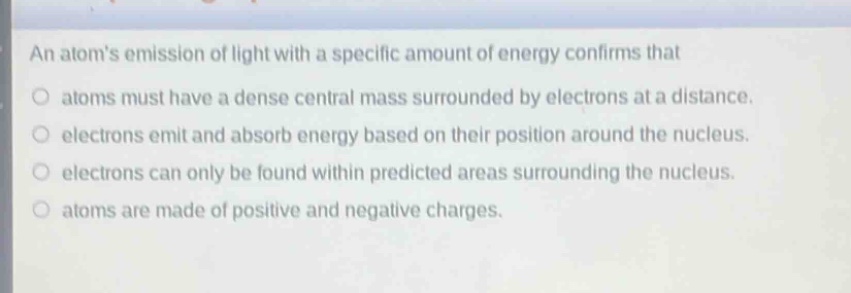
an atoms emission of light with a specific amount of energy confirms that\natoms must have a dense central mass surrounded by electrons at a distance.\nelectrons emit and absorb energy based on their position around the nucleus.\nelectrons can only be found within predicted areas surrounding the nucleus.\natoms are made of positive and negative charges.
Answer
Explanation:
Step1: Analyze each option
- Option 1: The emission of light with specific energy does not relate to the dense central mass (nucleus) - electron distance structure in terms of confirming it.
- Option 2: According to quantum mechanics, electrons in an atom exist in discrete energy levels. When an electron moves from a higher - energy level to a lower - energy level, it emits light with an energy equal to the difference in energy between the two levels. And when it absorbs energy, it moves to a higher - energy level. So, the emission of light with a specific amount of energy confirms that electrons emit and absorb energy based on their position (energy level) around the nucleus.
- Option 3: The fact that an atom emits light with a specific energy is more about energy levels (related to electron transitions between energy levels) rather than just the predicted areas (orbitals) where electrons can be found. Orbitals describe the probability of finding an electron in a certain region, but the emission of specific - energy light is more about energy level changes.
- Option 4: The statement that atoms are made of positive and negative charges is a general property of atoms (protons are positive, electrons are negative), but it has no direct relation to the emission of light with a specific amount of energy.
Answer:
electrons emit and absorb energy based on their position around the nucleus.