badri makes the table below to review the factors that affect the electric force between objects. which…
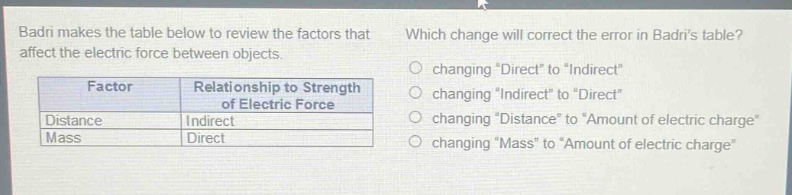
badri makes the table below to review the factors that affect the electric force between objects. which change will correct the error in badris table? changing \direct\ to \indirect\ changing \indirect\ to \direct\ changing \distance\ to \amount of electric charge\ changing \mass\ to \amount of electric charge\ factor relationship to strength of electric force distance indirect mass direct
Answer
Explanation:
Step1: Recall electric - force formula
The electric force between two charged objects is given by Coulomb's law $F = k\frac{q_1q_2}{r^2}$, where $F$ is the electric force, $k$ is a constant, $q_1$ and $q_2$ are the amounts of electric charge of the two objects, and $r$ is the distance between them. The electric force is directly proportional to the product of the charges and inversely proportional to the square of the distance between them. Mass has no direct relation to the electric force between charged objects.
Step2: Analyze the table
In the table, distance has an indirect (inverse - square) relationship with the electric - force strength which is correct. But mass has no relation to the electric force, and the amount of electric charge should be considered instead.
Answer:
changing "Mass" to "Amount of electric charge"