a ball is dropped from above ground level and hits the ground sometime between 4 and 6 seconds after it is…
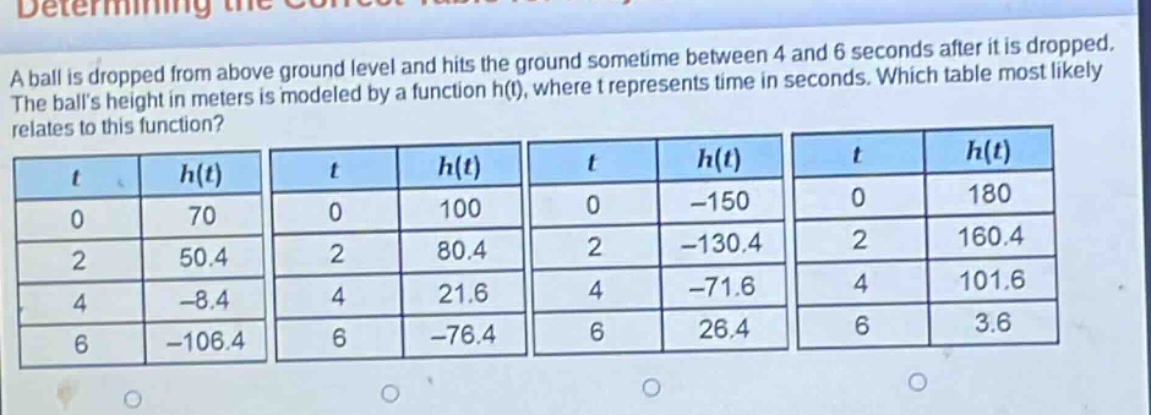
a ball is dropped from above ground level and hits the ground sometime between 4 and 6 seconds after it is dropped. the balls height in meters is modeled by a function h(t), where t represents time in seconds. which table most likely relates to this function? t h(t) 0 70 2 50.4 4 -8.4 6 -106.4 t h(t) 0 100 2 80.4 4 21.6 6 -76.4 t h(t) 0 -150 2 -130.4 4 -71.6 6 26.4 t h(t) 0 180 2 160.4 4 101.6 6 3.6
Answer
Answer:
The fourth table (with (t = 0,h(t)=180); (t = 2,h(t)=160.4); (t = 4,h(t)=101.6); (t = 6,h(t)=3.6))
Explanation:
Step1: Analyze height at (t = 0)
The ball is dropped from above - ground level, so (h(0)>0). Eliminate the third table ((h(0)= - 150)).
Step2: Analyze height between (4) and (6) s
The ball hits the ground between (4) and (6) seconds. So (h(t)) should be non - negative before hitting the ground and close to (0) at the time of hitting. In the first table, (h(4)=-8.4) which means it has already passed the ground level before (4) s. In the second table, (h(6)=-76.4) which means it has gone below the ground level at (t = 6) s. In the fourth table, (h(4)=101.6) and (h(6)=3.6), which is consistent with hitting the ground between (4) and (6) s.