a ball has a mass of 0.25 kg and is moving to the right at 1.0 m/s. it hits a ball of mass 0.15 kg that is…
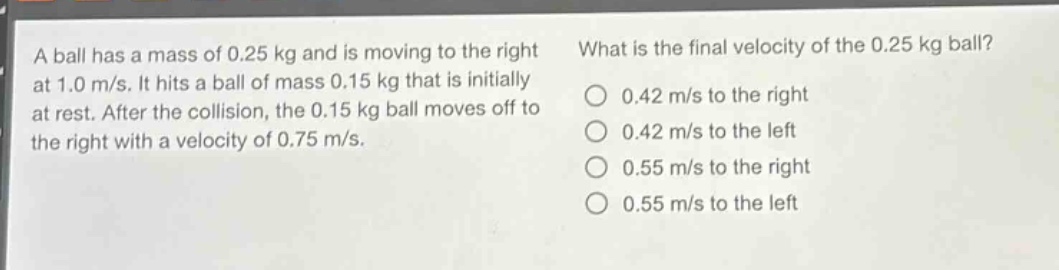
a ball has a mass of 0.25 kg and is moving to the right at 1.0 m/s. it hits a ball of mass 0.15 kg that is initially at rest. after the collision, the 0.15 kg ball moves off to the right with a velocity of 0.75 m/s. what is the final velocity of the 0.25 kg ball? 0.42 m/s to the right 0.42 m/s to the left 0.55 m/s to the right 0.55 m/s to the left
Answer
Explanation:
Step1: Apply conservation of momentum
The law of conservation of momentum is $m_1u_1 + m_2u_2=m_1v_1 + m_2v_2$. Let the first - ball have mass $m_1 = 0.25$ kg, initial velocity $u_1=1.0$ m/s, and final velocity $v_1$. The second - ball has mass $m_2 = 0.15$ kg, initial velocity $u_2 = 0$ m/s, and final velocity $v_2=0.75$ m/s. Substitute the values into the formula: $(0.25\times1.0)+(0.15\times0)=(0.25\times v_1)+(0.15\times0.75)$.
Step2: Simplify the equation
The left - hand side of the equation is $0.25\times1.0+0.15\times0 = 0.25$. The right - hand side is $0.25v_1+0.1125$. So, $0.25=0.25v_1 + 0.1125$.
Step3: Solve for $v_1$
First, subtract 0.1125 from both sides: $0.25−0.1125 = 0.25v_1$. Then, $0.1375 = 0.25v_1$. Divide both sides by 0.25: $v_1=\frac{0.1375}{0.25}=0.55$ m/s. Since the value is positive, the direction is to the right.
Answer:
0.55 m/s to the right