a ball rolls from point a to point b. the total energy of the ball at point a isnt the same as the sum of…
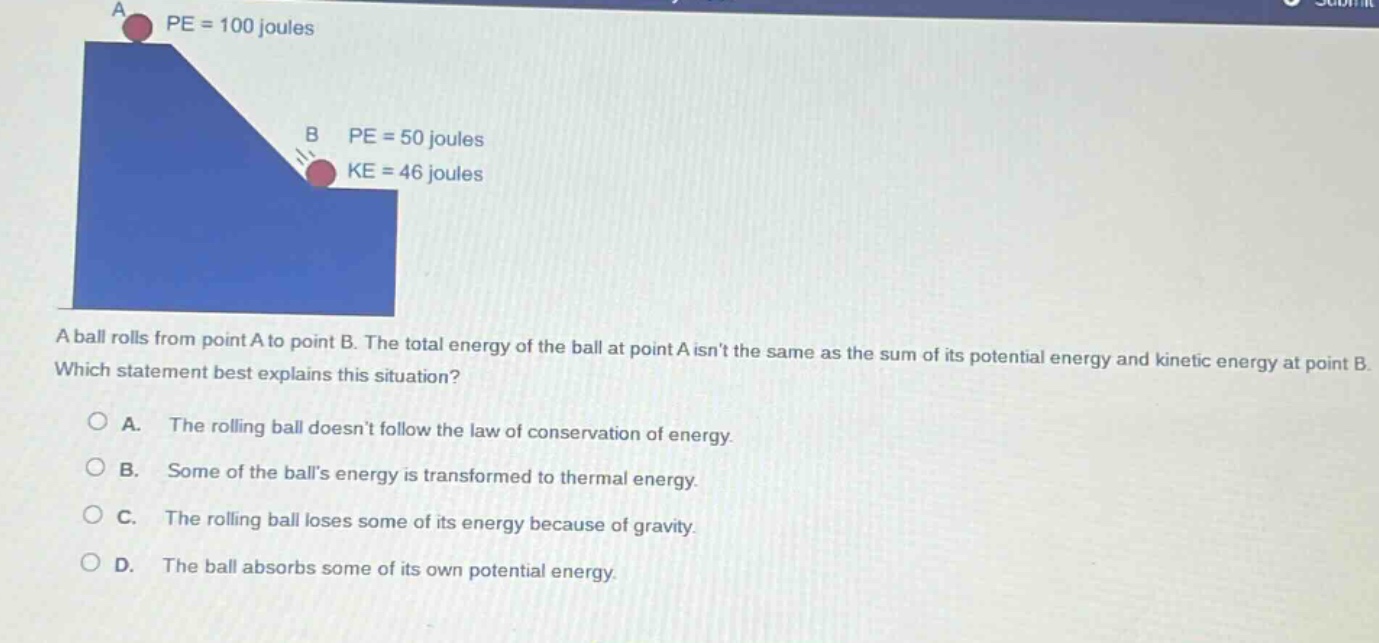
a ball rolls from point a to point b. the total energy of the ball at point a isnt the same as the sum of its potential energy and kinetic energy at point b. which statement best explains this situation?\na. the rolling ball doesnt follow the law of conservation of energy.\nb. some of the balls energy is transformed to thermal energy.\nc. the rolling ball loses some of its energy because of gravity.\nd. the ball absorbs some of its own potential energy.
Answer
Brief Explanations:
- Option A: The law of conservation of energy is a fundamental law in physics. All physical systems (including a rolling ball) follow this law. So, this option is incorrect.
- Option B: When the ball rolls, there is friction between the ball and the surface. Friction causes some of the mechanical energy (sum of potential and kinetic energy) to be converted into thermal energy (heat). This explains why the total energy at point A ($PE = 100$ J) is not equal to the sum of $PE+KE$ at point B ($50 + 46=96$ J). The “missing” energy is converted to thermal energy due to friction.
- Option C: Gravity is a conservative force. It does not cause a loss of mechanical energy. Instead, it can convert potential energy to kinetic energy (and vice - versa). So, this option is incorrect.
- Option D: A ball cannot absorb its own potential energy. Potential energy is a form of energy associated with the position of the ball in a gravitational field. So, this option is incorrect.
Answer:
B. Some of the ball's energy is transformed to thermal energy.