3. a ball is suspended by a lightweight string, as shown in the figure below, where it is projected in front…
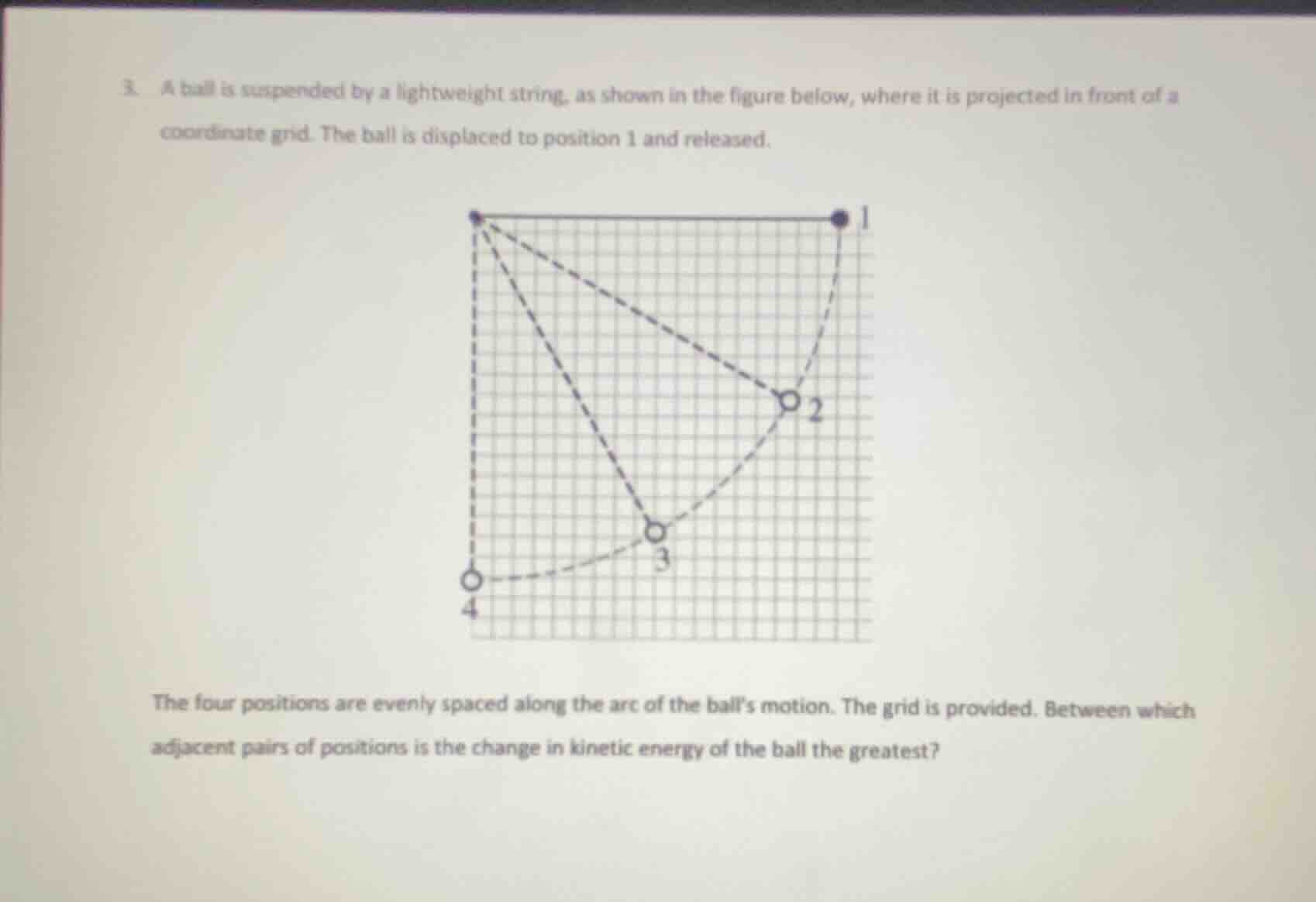
3. a ball is suspended by a lightweight string, as shown in the figure below, where it is projected in front of a coordinate grid. the ball is displaced to position 1 and released.\n\nthe four positions are evenly spaced along the arc of the balls motion. the grid is provided. between which adjacent pairs of positions is the change in kinetic energy of the ball the greatest?
Answer
Explanation:
Step1: Relate kinetic energy change to potential energy
By the conservation of energy, the change in kinetic energy ($\Delta K$) equals the negative change in gravitational potential energy ($\Delta U$). $$\Delta K = -\Delta U = mg \Delta h$$
Step2: Identify the vertical displacement for each interval
The change in kinetic energy is proportional to the vertical distance ($\Delta h$) traveled between two points. $$\Delta K \propto \Delta h$$
Step3: Measure vertical drops from the grid
Count the grid units for vertical displacement between adjacent points:
- From 1 to 2: The ball drops approximately 4 units.
- From 2 to 3: The ball drops approximately 6 units.
- From 3 to 4: The ball drops approximately 2 units.
Step4: Compare the vertical displacements
The vertical drop $\Delta h$ is greatest between position 2 and position 3.
Answer:
Between position 2 and position 3.