a ball is thrown straight up into the air. the table shows the data collected over t seconds, where h(t) is…
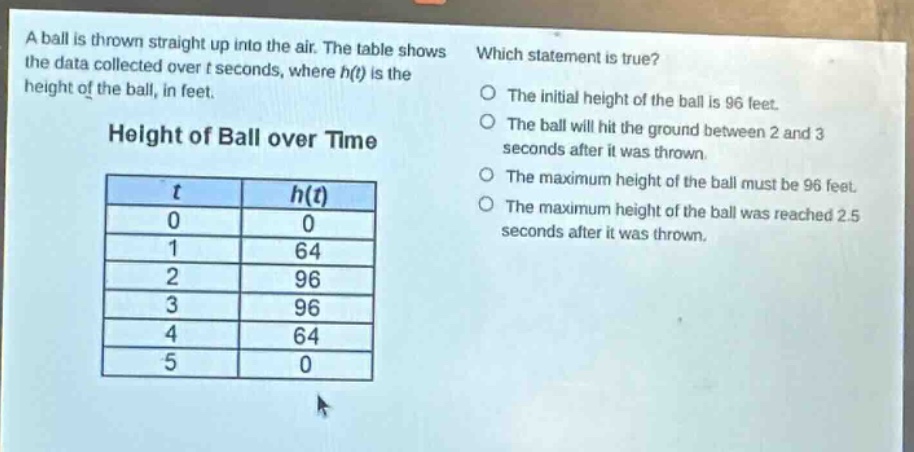
a ball is thrown straight up into the air. the table shows the data collected over t seconds, where h(t) is the height of the ball, in feet.\nheight of ball over time\n| t | h(t) |\n|----|----|\n| 0 | 0 |\n| 1 | 64 |\n| 2 | 96 |\n| 3 | 96 |\n| 4 | 64 |\n| 5 | 0 |\nwhich statement is true?\nthe initial height of the ball is 96 feet.\nthe ball will hit the ground between 2 and 3 seconds after it was thrown.\nthe maximum height of the ball must be 96 feet.\nthe maximum height of the ball was reached 2.5 seconds after it was thrown.
Answer
Explanation:
Step1: Check initial height
When (t = 0), (h(0)=0), so the initial height is 0 feet, not 96 feet.
Step2: Check when ball hits ground
The ball hits the ground when (h(t)=0). We see (h(0) = 0) (start - not hitting ground after being thrown) and (h(5)=0), so it hits the ground at (t = 5) seconds, not between 2 and 3 seconds.
Step3: Check maximum height
The height values are (h(0)=0), (h(1) = 64), (h(2)=96), (h(3)=96), (h(4)=64), (h(5)=0). The maximum height is 96 feet.
Step4: Check time of maximum - height
The ball reaches 96 feet at (t = 2) seconds and (t = 3) seconds, not at (t=2.5) seconds.
Answer:
The maximum height of the ball must be 96 feet.