a ball is thrown straight up into the air. the table shows the data collected over t seconds, where h(t) is…
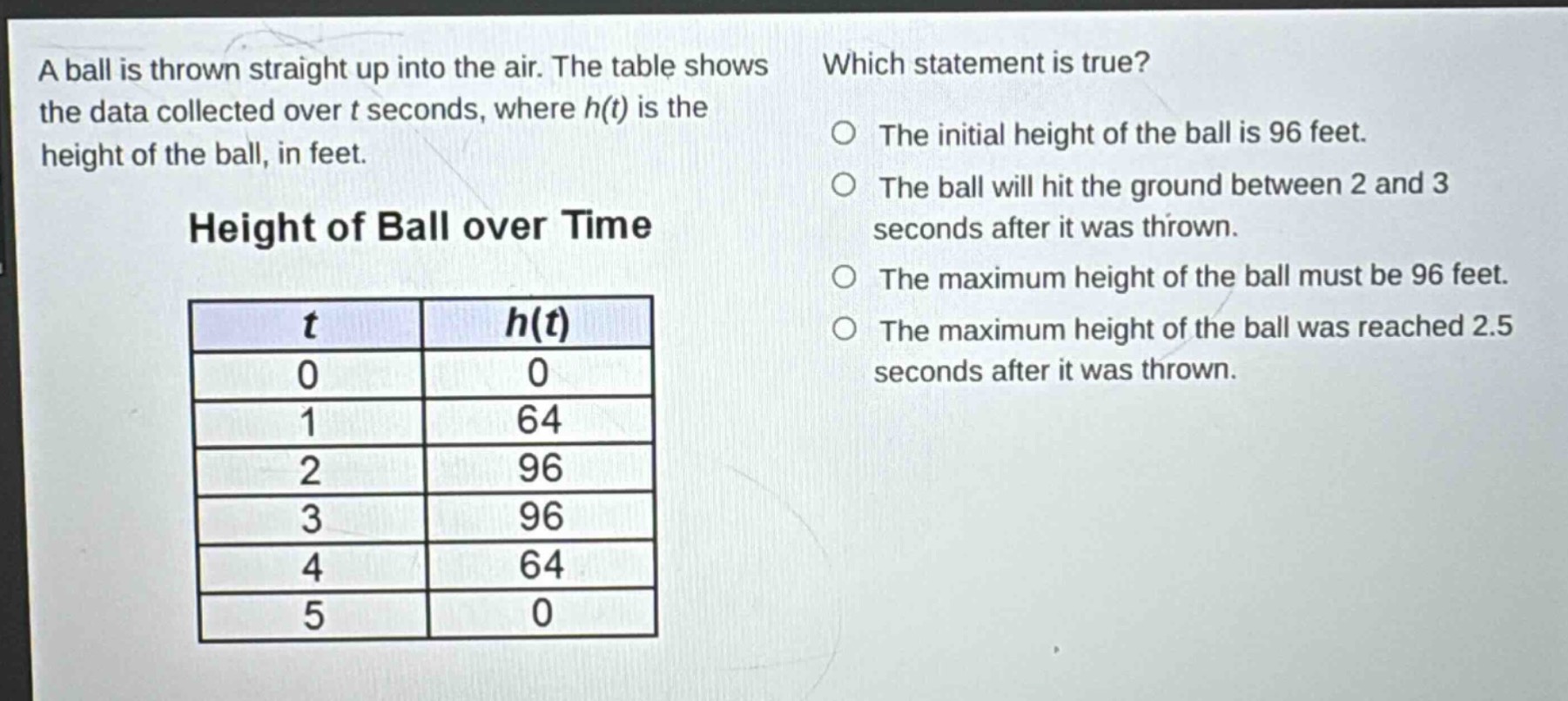
a ball is thrown straight up into the air. the table shows the data collected over t seconds, where h(t) is the height of the ball, in feet. height of ball over time\n| t | h(t) |\n|----|----| \n| 0 | 0 |\n| 1 | 64 |\n| 2 | 96 |\n| 3 | 96 |\n| 4 | 64 |\n| 5 | 0 |\nwhich statement is true?\nthe initial height of the ball is 96 feet.\nthe ball will hit the ground between 2 and 3 seconds after it was thrown.\nthe maximum height of the ball must be 96 feet.\nthe maximum height of the ball was reached 2.5 seconds after it was thrown.
Answer
Explanation:
Step1: Check initial height
When (t = 0), (h(0)=0), so the initial height is 0 feet, not 96 feet.
Step2: Check when ball hits ground
The ball's height (h(t) = 0) at (t = 0) (start) and (t=5). It does not hit the ground between 2 and 3 seconds.
Step3: Analyze maximum height
The ball's height is 96 feet at (t = 2) and (t = 3). Since the height - time relationship is symmetric (parabolic for free - fall motion), the maximum height occurs at (t=\frac{2 + 3}{2}=2.5) seconds. Also, we can't say the maximum height must be 96 feet just from the table values, as there could be higher values between the measured points, but we know the maximum is reached at 2.5 seconds.
Answer:
The maximum height of the ball was reached 2.5 seconds after it was thrown.