a ball is thrown straight up into the air. the table shows the data collected over t seconds, where h(t) is…
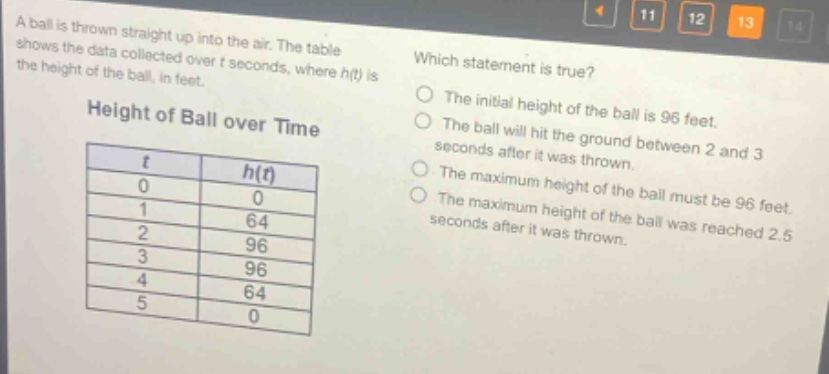
a ball is thrown straight up into the air. the table shows the data collected over t seconds, where h(t) is the height of the ball, in feet. height of ball over time which statement is true? the initial height of the ball is 96 feet. the ball will hit the ground between 2 and 3 seconds after it was thrown. the maximum height of the ball must be 96 feet. the maximum height of the ball was reached 2.5 seconds after it was thrown.\n|t|h(t)|\n|0|0|\n|1|64|\n|2|96|\n|3|96|\n|4|64|\n|5|0|
Answer
Answer:
The ball will hit the ground between 2 and 3 seconds after it was thrown.
Explanation:
Step1: Analyze initial height
When (t = 0), (h(0)=0), so initial height is 0 feet, not 96 feet.
Step2: Analyze hitting - ground time
At (t = 2), (h(2)=96) and at (t = 3), (h(3)=96), at (t = 5), (h(5)=0). Since height is a continuous function of time for a ball in free - fall, it must hit the ground between 2 and 5 seconds, and specifically between 2 and 3 seconds as the height starts to decrease after (t = 2).
Step3: Analyze maximum height time
There is no information to suggest that the maximum height was reached at (t = 2.5) seconds. Also, we can't be sure the maximum height is 96 feet just from this data. The ball could have gone higher between (t = 1) and (t = 2) or between (t = 2) and (t = 3).