a baseball is thrown into the air from a height of 5 feet. the ball reaches a maximum height of 43.5 feet…
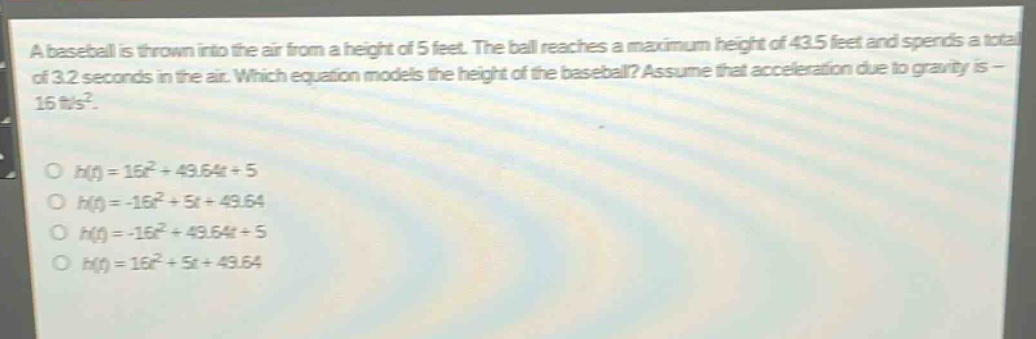
a baseball is thrown into the air from a height of 5 feet. the ball reaches a maximum height of 43.5 feet and spends a total of 3.2 seconds in the air. which equation models the height of the baseball? assume that acceleration due to gravity is - 16 ft/s².\n\no (h(t)=16t^{2}+49.64t + 5)\no (h(t)=-16t^{2}+5t + 49.64)\no (h(t)=-16t^{2}+49.64t + 5)\no (h(t)=16t^{2}+5t + 49.64)
Answer
Explanation:
Step1: Recall the general form of vertical - motion equation
The general form of the height - time equation for vertical motion under gravity is $h(t)=at^{2}+v_{0}t + h_{0}$, where $a$ is the acceleration due to gravity, $v_{0}$ is the initial velocity, and $h_{0}$ is the initial height. Given that the acceleration due to gravity $a=- 16$ ft/s² and the initial height $h_{0} = 5$ feet. So the equation is of the form $h(t)=-16t^{2}+v_{0}t + 5$.
Step2: Analyze the options
We know the correct form has $a=-16$, so we can eliminate the options with $a = 16$ (i.e., $h(t)=16t^{2}+49.64t + 5$ and $h(t)=16t^{2}+5t + 49.64$). Also, the constant term in the equation should be the initial height. The initial height is 5 feet, so the equation should be $h(t)=-16t^{2}+v_{0}t + 5$. Among the remaining options, the correct one is $h(t)=-16t^{2}+49.64t + 5$.
Answer:
$h(t)=-16t^{2}+49.64t + 5$