basims robotics team builds a robot that travels at 9 m/s and can fire a tennis ball at a target. which…
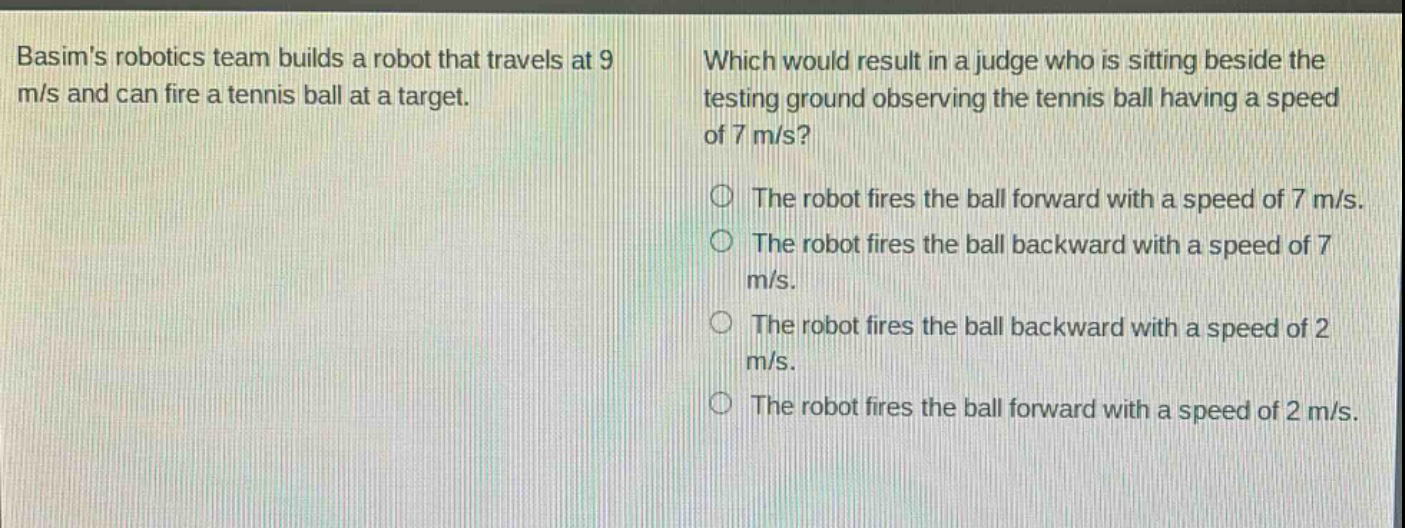
basims robotics team builds a robot that travels at 9 m/s and can fire a tennis ball at a target. which would result in a judge who is sitting beside the testing ground observing the tennis ball having a speed of 7 m/s? the robot fires the ball forward with a speed of 7 m/s. the robot fires the ball backward with a speed of 7 m/s. the robot fires the ball backward with a speed of 2 m/s. the robot fires the ball forward with a speed of 2 m/s.
Answer
Answer:
The robot fires the ball backward with a speed of 2 m/s.
Explanation:
Step1: Understand relative - velocity concept
The robot is moving at a speed of $v_{robot}=9$ m/s. Let the speed of the ball relative to the robot be $v_{ball - robot}$ and the speed of the ball relative to the ground be $v_{ball - ground}$. The formula for relative velocity is $v_{ball - ground}=v_{robot}+v_{ball - robot}$.
Step2: Analyze forward - firing cases
If the robot fires the ball forward:
- If $v_{ball - robot}=7$ m/s, then $v_{ball - ground}=9 + 7=16$ m/s.
- If $v_{ball - robot}=2$ m/s, then $v_{ball - ground}=9 + 2 = 11$ m/s.
Step3: Analyze backward - firing cases
If the robot fires the ball backward:
- If $v_{ball - robot}=7$ m/s, then $v_{ball - ground}=9-7 = 2$ m/s.
- If $v_{ball - robot}=2$ m/s, then $v_{ball - ground}=9 - 2=7$ m/s. So when the robot fires the ball backward with a speed of 2 m/s, the speed of the ball observed by the judge on the ground is 7 m/s.