a beam of mass m = 3.0 kg and length 10.0 m hangs from a cable through point p. the mass of the beam is…
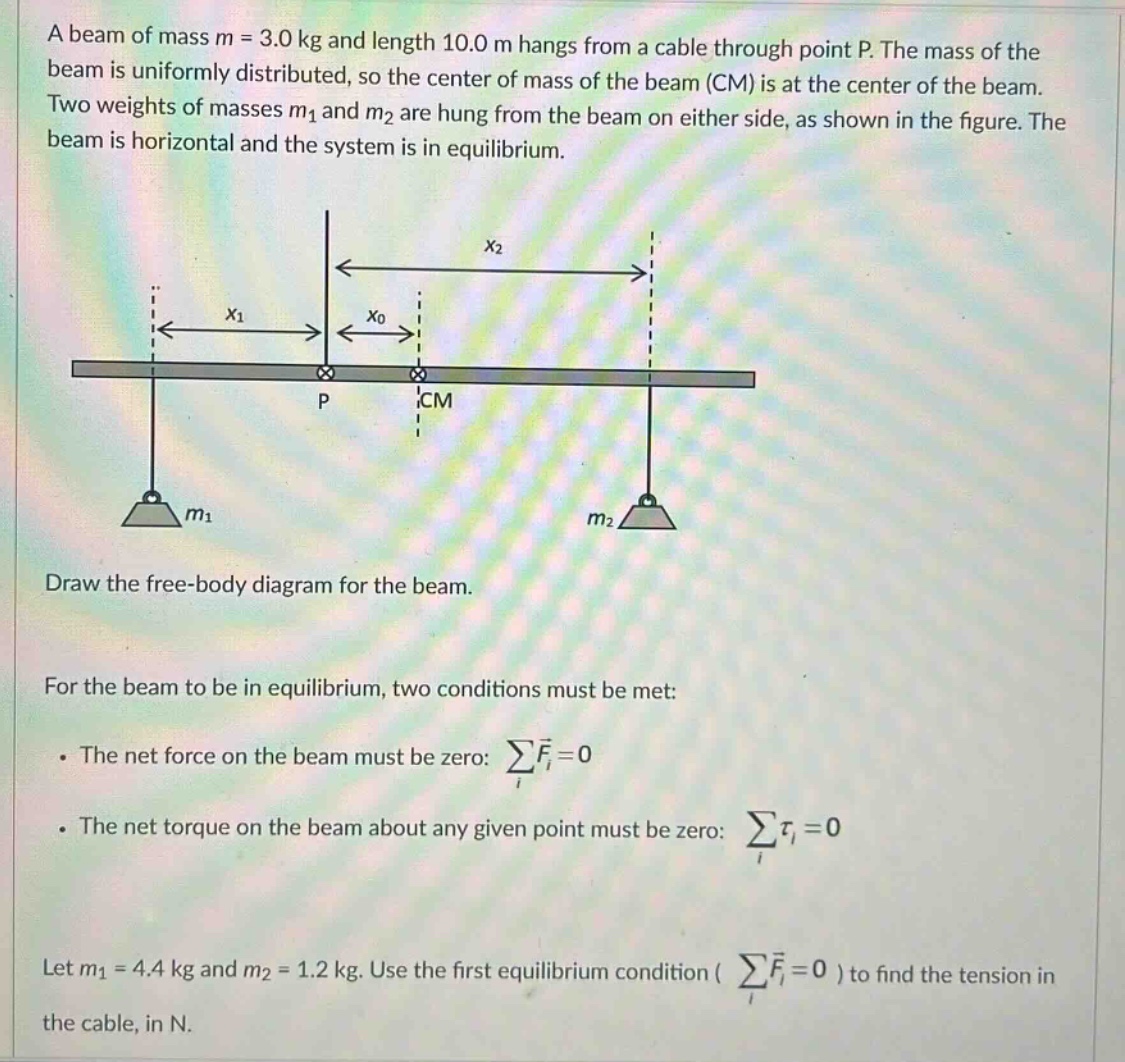
a beam of mass m = 3.0 kg and length 10.0 m hangs from a cable through point p. the mass of the beam is uniformly distributed, so the center of mass of the beam (cm) is at the center of the beam. two weights of masses m1 and m2 are hung from the beam on either side, as shown in the figure. the beam is horizontal and the system is in equilibrium.\ndraw the free - body diagram for the beam.\nfor the beam to be in equilibrium, two conditions must be met:\n. the net force on the beam must be zero: $sum_{i}vec{f}_{i}=0$\n. the net torque on the beam about any given point must be zero: $sum_{i}\tau_{i}=0$\nlet m1 = 4.4 kg and m2 = 1.2 kg. use the first equilibrium condition ($sum_{i}vec{f}_{i}=0$) to find the tension in the cable, in n.
Answer
Explanation:
Step1: Identify the forces acting on the beam
The forces are the gravitational - forces of $m_1$, $m_2$, $m$ and the tension $T$ in the cable. The gravitational force of an object of mass $m$ is given by $F = mg$, where $g = 9.8\ m/s^2$. The gravitational force of $m_1$ is $F_{1}=m_1g$, the gravitational force of $m_2$ is $F_{2}=m_2g$, the gravitational force of the beam is $F_{beam}=mg$.
Step2: Apply the first - equilibrium condition $\sum\vec{F}_i = 0$
In the vertical direction, the upward force is the tension $T$ in the cable, and the downward forces are $F_{1}$, $F_{2}$, and $F_{beam}$. So, $\sum F_y=T - m_1g - m_2g - mg=0$. We can re - arrange this equation to solve for $T$: $T=(m_1 + m_2 + m)g$.
Step3: Substitute the given values
Given $m_1 = 4.4\ kg$, $m_2 = 1.2\ kg$, and $m = 3.0\ kg$, and $g = 9.8\ m/s^2$. $T=(4.4 + 1.2+3.0)\times9.8$. First, calculate the sum of the masses: $4.4 + 1.2+3.0 = 8.6\ kg$. Then, calculate the tension: $T = 8.6\times9.8=84.28\ N$.
Answer:
$84.28$