behavior of gases - problems\ncheck all of the following changes that would decrease the pressure inside a…
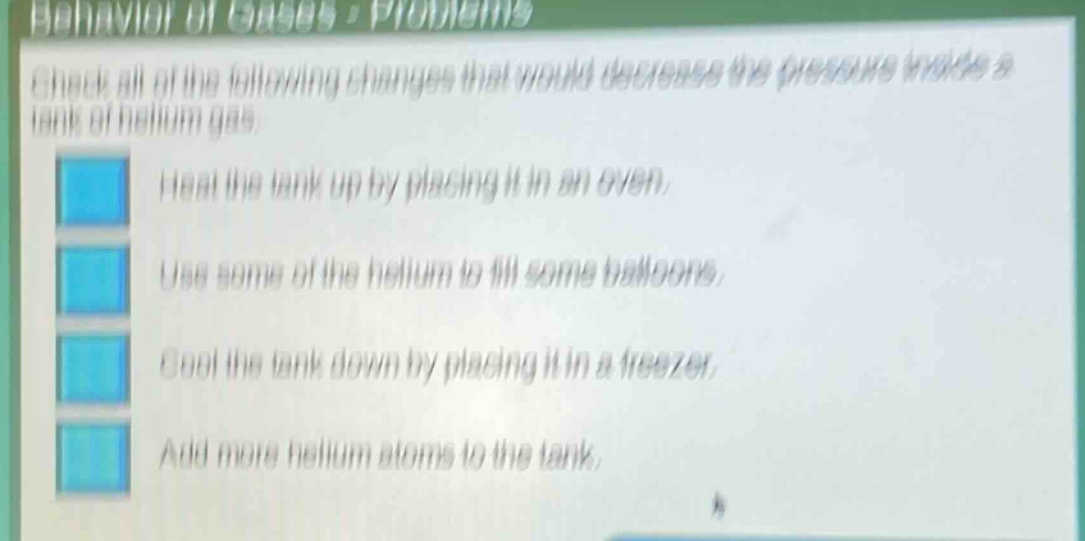
behavior of gases - problems\ncheck all of the following changes that would decrease the pressure inside a tank of helium gas.\nheat the tank up by placing it in an oven.\nuse some of the helium to fill some balloons.\ncool the tank down by placing it in a freezer.\nadd more helium atoms to the tank.
Answer
Explanation:
Step1: Recall gas - law principles
According to the ideal gas law $PV = nRT$ (where $P$ is pressure, $V$ is volume, $n$ is the number of moles, $R$ is the ideal - gas constant, and $T$ is temperature). If volume is constant (as in a tank), $P$ is directly proportional to $n$ and $T$.
Step2: Analyze heating the tank
Heating the tank ($T$ increases) while volume is constant will increase the pressure according to $P=\frac{nR}{V}T$. So, "Heat the tank up by placing it in an oven" does not decrease pressure.
Step3: Analyze using some helium
Using some of the helium to fill balloons decreases the number of moles ($n$) of helium in the tank. With constant volume and temperature, from $P=\frac{nR}{V}T$, a decrease in $n$ will decrease the pressure.
Step4: Analyze cooling the tank
Cooling the tank ($T$ decreases) while volume is constant will decrease the pressure according to $P=\frac{nR}{V}T$.
Step5: Analyze adding more helium
Adding more helium atoms to the tank increases the number of moles ($n$). With constant volume and temperature, from $P=\frac{nR}{V}T$, an increase in $n$ will increase the pressure.
Answer:
- Use some of the helium to fill some balloons
- Cool the tank down by placing it in a freezer