which best describes the tyndall effect?\nthe scattering of light by solutes in a mixture\nthe scattering of…
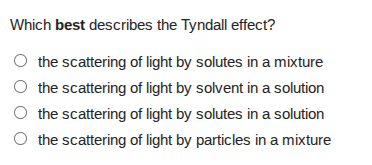
which best describes the tyndall effect?\nthe scattering of light by solutes in a mixture\nthe scattering of light by solvent in a solution\nthe scattering of light by solutes in a solution\nthe scattering of light by particles in a mixture
Answer
Answer:
D. the scattering of light by particles in a mixture
Brief Explanations:
The Tyndall effect is defined as the scattering of visible light by colloid-sized particles suspended in a mixture (either a colloid or a very fine suspension). Solutes in true solutions are too small to scatter light, so options involving solutes or solvent scattering are incorrect.