which best explains why a satellite accelerates?\nit is always changing direction.\nit is constantly slowed…
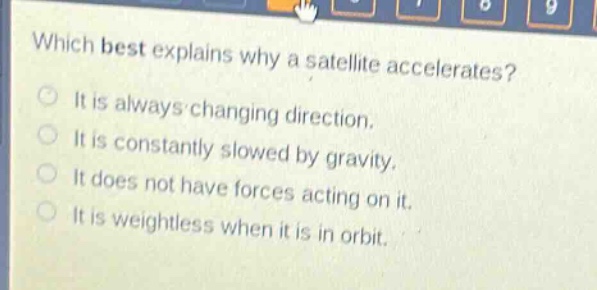
which best explains why a satellite accelerates?\nit is always changing direction.\nit is constantly slowed by gravity.\nit does not have forces acting on it.\nit is weightless when it is in orbit.
Answer
Brief Explanations:
Acceleration is a change in velocity. Velocity is a vector (has magnitude and direction). A satellite in orbit is in circular - like motion. In circular motion, the direction of the velocity vector is constantly changing (tangent to the circular path at each point). Even if the speed (magnitude of velocity) is constant (in a circular orbit with no external non - gravitational forces doing work to change speed), the change in direction means there is a change in velocity. According to the definition of acceleration ($a=\frac{\Delta\vec{v}}{\Delta t}$), a change in velocity implies acceleration.
- For the option “It is constantly slowed by gravity”: In a stable orbit (assuming no atmospheric drag etc.), the satellite's speed (magnitude of velocity) is not constantly being slowed. Gravity provides the centripetal force for the circular motion, not a force to slow the satellite in the sense of reducing its orbital speed (in a simple circular orbit model).
- For the option “It does not have forces acting on it”: A satellite in orbit has a gravitational force acting on it. The gravitational force of the Earth (or the body it is orbiting) provides the centripetal force for its motion.
- For the option “It is weightless when it is in orbit”: Weight is the force due to gravity ($W = mg$). In orbit, the satellite still has mass and is in a gravitational field, so it is not weightless. The term “apparent weightlessness” is due to the fact that the satellite and everything in it are in free - fall (accelerating towards the Earth at the same rate as the objects inside the satellite). But this has no direct relation to the reason for acceleration.
Answer:
It is always changing direction.