beverly and carl are in a race. their graphs show the data. which best describes the race? even though for a…
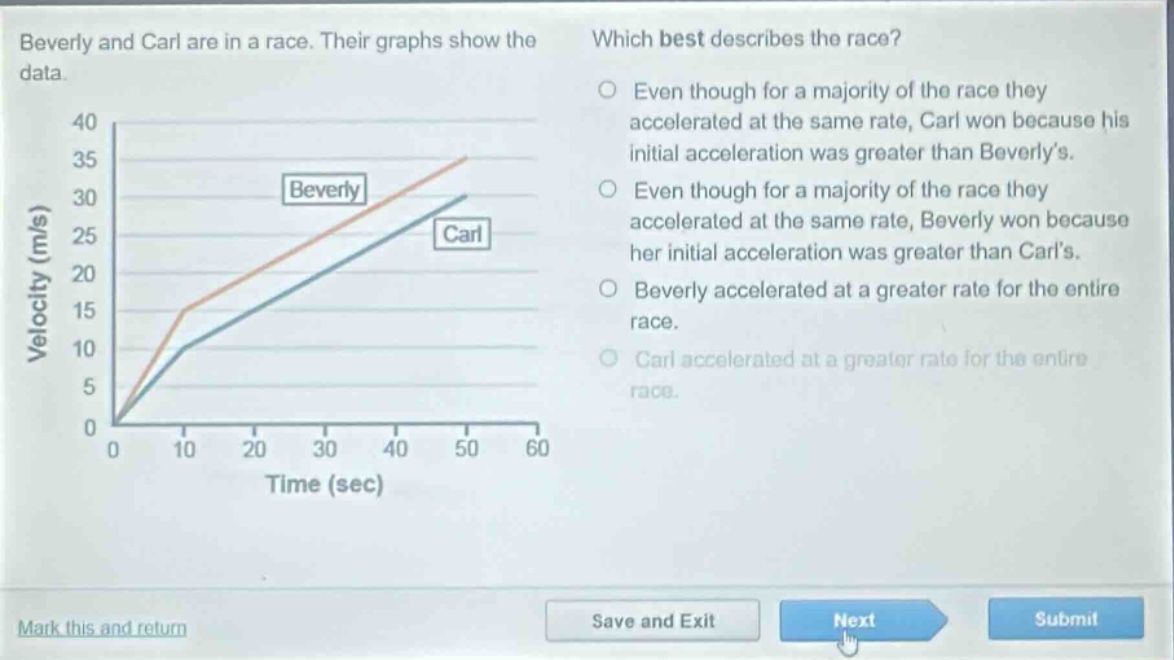
beverly and carl are in a race. their graphs show the data. which best describes the race? even though for a majority of the race they accelerated at the same rate, carl won because his initial acceleration was greater than beverly’s. even though for a majority of the race they accelerated at the same rate, beverly won because her initial acceleration was greater than carl’s. beverly accelerated at a greater rate for the entire race. carl accelerated at a greater rate for the entire race.
Answer
Explanation:
Step1: Recall acceleration - velocity graph relationship
Acceleration is the slope of the velocity - time graph.
Step2: Analyze the initial part of the graph
In the beginning (first 10 seconds), Beverly's velocity - time graph has a steeper slope than Carl's, so Beverly has a greater initial acceleration.
Step3: Analyze the later part of the graph
For the majority of the race (after 10 seconds), the slopes of their velocity - time graphs are approximately the same, meaning they accelerate at the same rate.
Step4: Determine the winner
Since Beverly has a greater initial acceleration and they have similar acceleration rates for most of the race, Beverly wins.
Answer:
Even though for a majority of the race they accelerated at the same rate, Beverly won because her initial acceleration was greater than Carl's.