a bowling ball has an initial momentum of +30 kg m/s and hits a stationary bowling pin. after the collision…
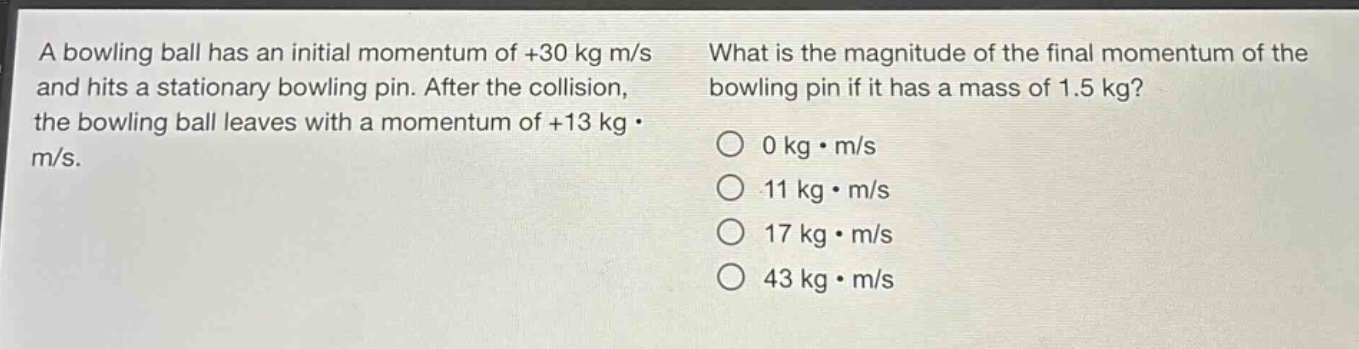
a bowling ball has an initial momentum of +30 kg m/s and hits a stationary bowling pin. after the collision, the bowling ball leaves with a momentum of +13 kg·m/s. what is the magnitude of the final momentum of the bowling pin if it has a mass of 1.5 kg? 0 kg·m/s 11 kg·m/s 17 kg·m/s 43 kg·m/s
Answer
Explanation:
Step1: Apply momentum - conservation principle
According to the law of conservation of momentum, the initial momentum of the system is equal to the final momentum of the system. The initial momentum of the system is the momentum of the bowling ball before the collision, $p_{i}=30\ kg\cdot m/s$. The final momentum of the system is the sum of the momentum of the bowling ball ($p_{b,f} = 13\ kg\cdot m/s$) and the momentum of the bowling pin ($p_{p,f}$). So, $p_{i}=p_{b,f}+p_{p,f}$.
Step2: Solve for the final momentum of the pin
Rearrange the equation $p_{i}=p_{b,f}+p_{p,f}$ to find $p_{p,f}$. We get $p_{p,f}=p_{i}-p_{b,f}$. Substitute $p_{i} = 30\ kg\cdot m/s$ and $p_{b,f}=13\ kg\cdot m/s$ into the equation. Then $p_{p,f}=30 - 13=17\ kg\cdot m/s$.
Answer:
C. 17 kg·m/s