a box experiences a force of 2 n to the left and 3 n to the right. which is true of the boxs motion? a the…
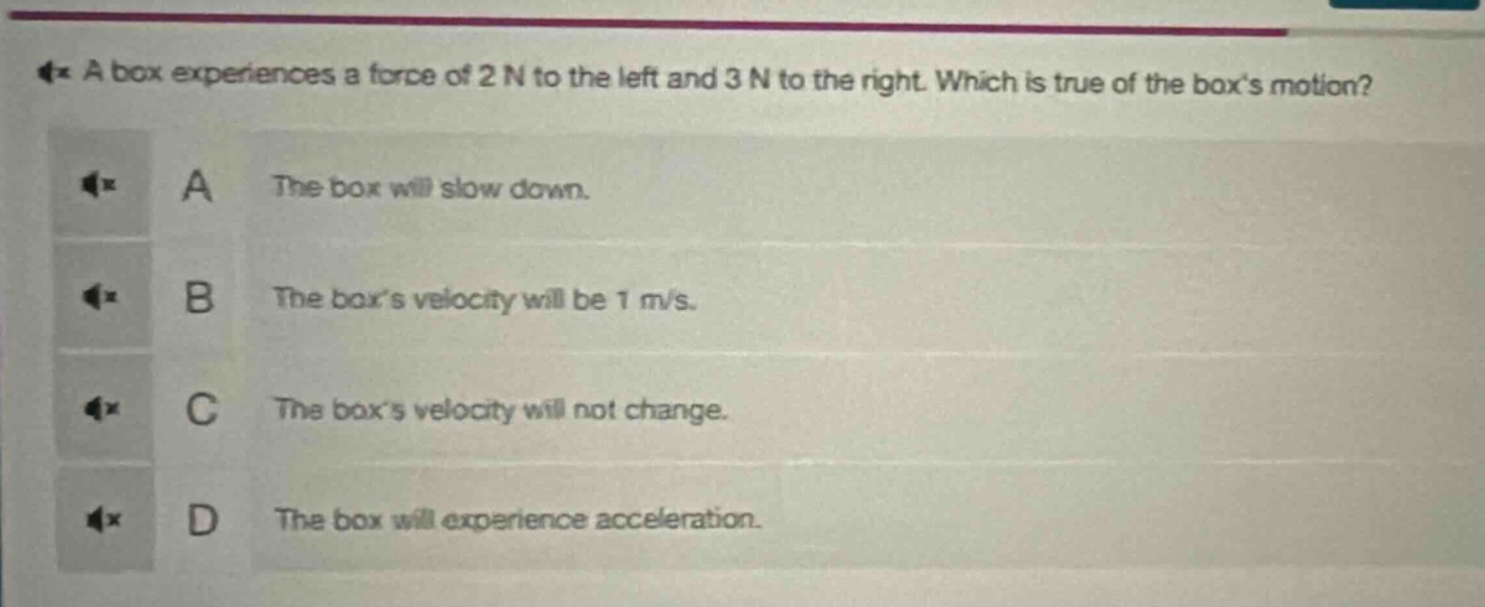
a box experiences a force of 2 n to the left and 3 n to the right. which is true of the boxs motion? a the box will slow down. b the boxs velocity will be 1 m/s. c the boxs velocity will not change. d the box will experience acceleration.
Answer
Answer:
D. The box will experience acceleration.
Explanation:
Step1: Calcular la fuerza neta
La fuerza neta $F_{net}$ se obtiene restando la fuerza hacia la izquierda de la fuerza hacia la derecha. Dado que $F_1 = 2N$ (izquierda) y $F_2=3N$ (derecha), entonces $F_{net}=F_2 - F_1=3N - 2N = 1N$ hacia la derecha.
Step2: Aplicar la segunda ley de Newton
Según la segunda ley de Newton $F = ma$, donde $F$ es la fuerza neta, $m$ es la masa del objeto y $a$ es la aceleración. Si $F_{net}\neq0$ (en este caso $F_{net}=1N$), y suponiendo que la masa $m$ del objeto es no - nula, entonces $a=\frac{F_{net}}{m}\neq0$. Esto significa que el objeto experimentará una aceleración. Las opciones A, B y C no son correctas porque: A) no hay información para decir que se ralentice; B) no se puede determinar la velocidad a partir de la información de fuerza dada; C) como hay fuerza neta, la velocidad cambiará.