boyle’s law ($p_1v_1 = p_2v_2$)\n● pump the handle twice to put some gas particles into the container.\n● in…
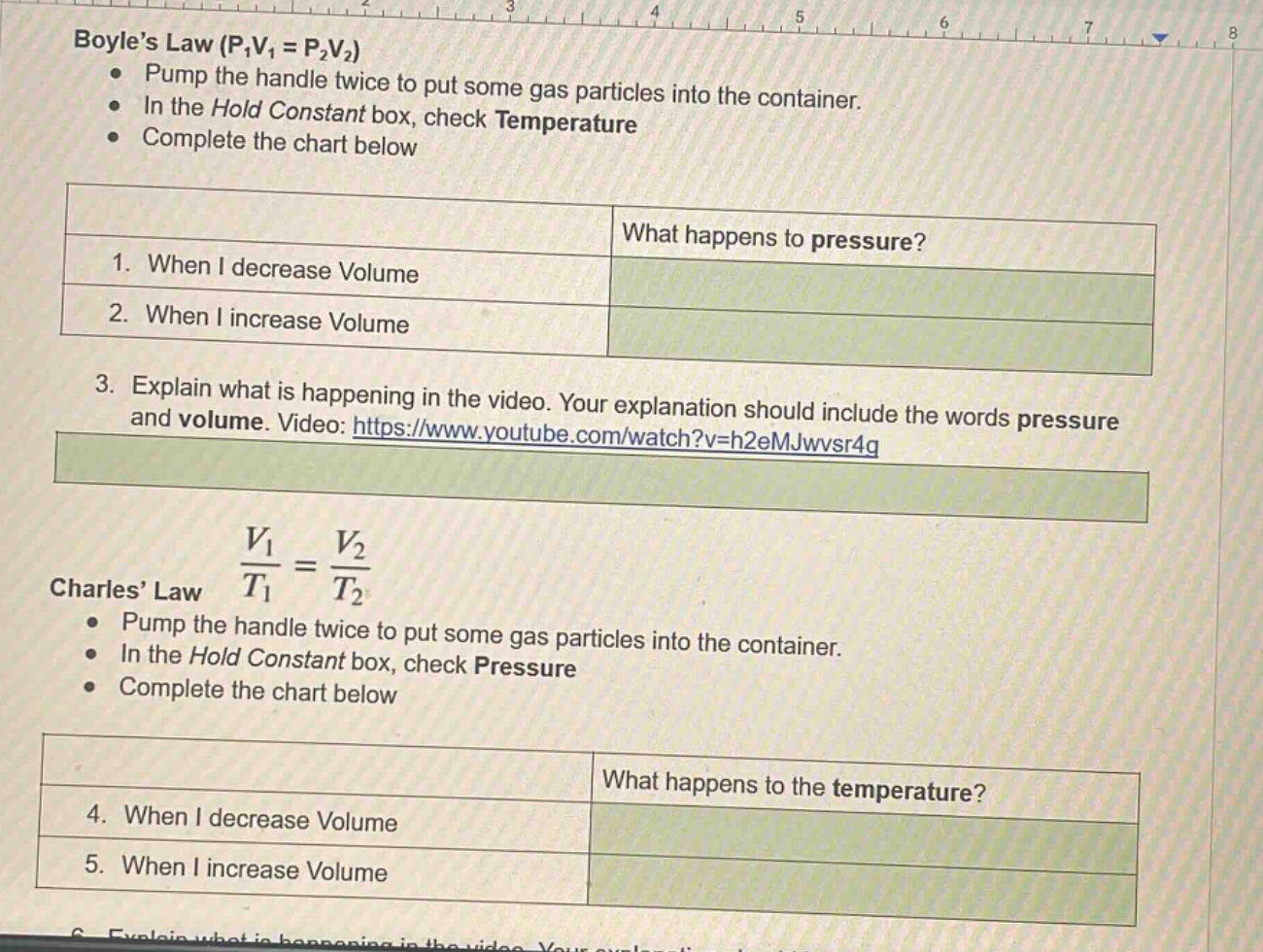
boyle’s law ($p_1v_1 = p_2v_2$)\n● pump the handle twice to put some gas particles into the container.\n● in the hold constant box, check temperature\n● complete the chart below\n\n| |what happens to pressure?|\n|--|--|\n|1. when i decrease volume| |\n|2. when i increase volume| |\n\n3. explain what is happening in the video. your explanation should include the words pressure and volume. video: https://www.youtube.com/watch?v=h2emjwvsr4g\n\ncharles’ law $\frac{v_1}{t_1}=\frac{v_2}{t_2}$\n● pump the handle twice to put some gas particles into the container.\n● in the hold constant box, check pressure\n● complete the chart below\n\n| |what happens to the temperature?|\n|--|--|\n|4. when i decrease volume| |\n|5. when i increase volume| |
Answer
Brief Explanations:
- Boyle's Law: This law describes the relationship between the pressure and volume of a gas at constant temperature and amount. It states that pressure and volume are inversely proportional ($P \propto \frac{1}{V}$ or $P_1V_1 = P_2V_2$). When the volume occupied by a gas decreases, the gas particles collide more frequently with the container walls, leading to an increase in pressure.
- Boyle's Law: Conversely, when the volume occupied by a gas increases, the gas particles have more space to move and collide less frequently with the container walls, resulting in a decrease in pressure.
- Video Explanation (General Boyle's Law Demonstration): The video likely demonstrates Boyle's Law by showing a fixed amount of gas at a constant temperature. As the volume of the container is changed (e.g., using a piston or syringe), the pressure exerted by the gas changes inversely. Decreasing the volume forces the gas particles into a smaller space, increasing the frequency of collisions with the container walls and thus increasing the pressure. Increasing the volume allows the particles more space, decreasing collision frequency and thus decreasing the pressure.
- Charles' Law: This law describes the relationship between the volume and temperature of a gas at constant pressure and amount. It states that volume and absolute temperature are directly proportional ($V \propto T$ or $\frac{V_1}{T_1} = \frac{V_2}{T_2}$). If the volume of a gas is decreased while keeping the pressure constant, the absolute temperature must also decrease. This is because lower temperature means lower kinetic energy of gas particles, which occupy less volume at constant pressure.
- Charles' Law: Conversely, if the volume of a gas is increased while keeping the pressure constant, the absolute temperature must also increase. Higher temperature means higher kinetic energy of gas particles, causing them to move more vigorously and occupy a larger volume at constant pressure.
Answer:
- When I decrease Volume, Pressure increases.
- When I increase Volume, Pressure decreases.
- The video demonstrates Boyle's Law, showing that for a fixed amount of gas at constant temperature, pressure and volume are inversely related. When the volume available to the gas decreases, the gas particles collide more often with the container walls, causing the pressure to increase. When the volume increases, there are fewer collisions, and the pressure decreases.
- When I decrease Volume, Temperature decreases.
- When I increase Volume, Temperature increases.