calculate the equivalent resistance for both circuits.\nseries circuit:\n2 ω and 4 ω\nparallel circuit:\n2 ω…
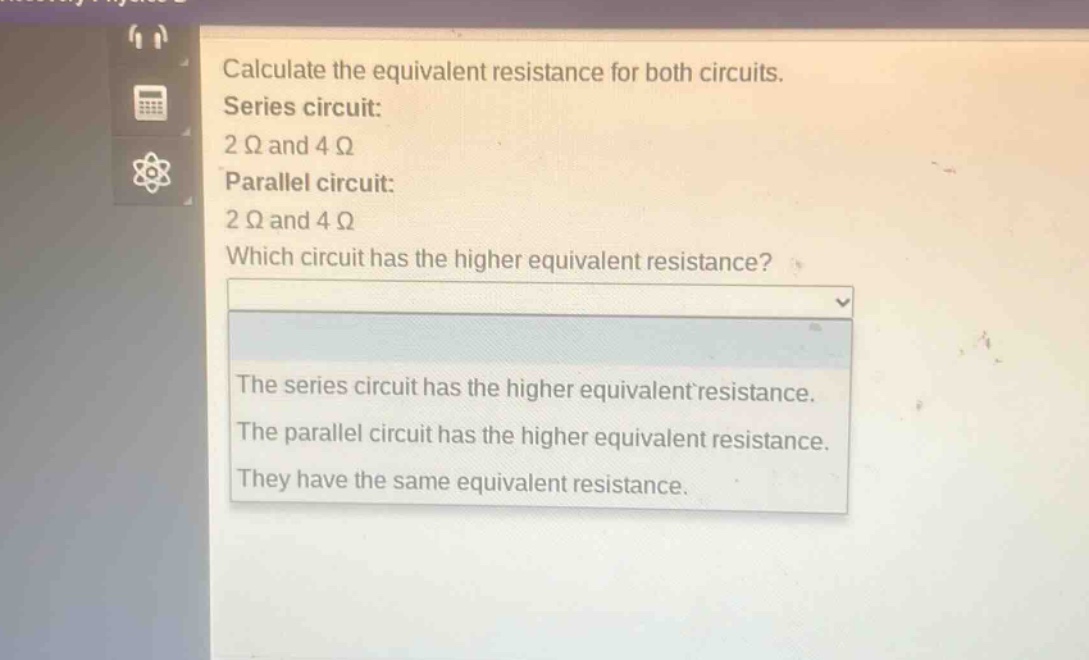
calculate the equivalent resistance for both circuits.\nseries circuit:\n2 ω and 4 ω\nparallel circuit:\n2 ω and 4 ω\nwhich circuit has the higher equivalent resistance?\nthe series circuit has the higher equivalent resistance.\nthe parallel circuit has the higher equivalent resistance.\nthey have the same equivalent resistance.
Answer
Explanation:
Step1: Calculate series - circuit resistance
For a series circuit, the equivalent resistance $R_s$ is the sum of individual resistances. Given $R_1 = 2\Omega$ and $R_2=4\Omega$, so $R_s=R_1 + R_2=2 + 4=6\Omega$.
Step2: Calculate parallel - circuit resistance
For a parallel circuit with two resistances $R_1$ and $R_2$, the formula for equivalent resistance $R_p$ is $\frac{1}{R_p}=\frac{1}{R_1}+\frac{1}{R_2}$. Substituting $R_1 = 2\Omega$ and $R_2 = 4\Omega$, we have $\frac{1}{R_p}=\frac{1}{2}+\frac{1}{4}=\frac{2 + 1}{4}=\frac{3}{4}$. Then $R_p=\frac{4}{3}\Omega\approx1.33\Omega$.
Step3: Compare resistances
Since $6\Omega>\frac{4}{3}\Omega$, the series - circuit has a higher equivalent resistance.
Answer:
The series circuit has the higher equivalent resistance.