the car on the left in the photo and in fig. 12-2 moves in a straight line such that for a short time its…
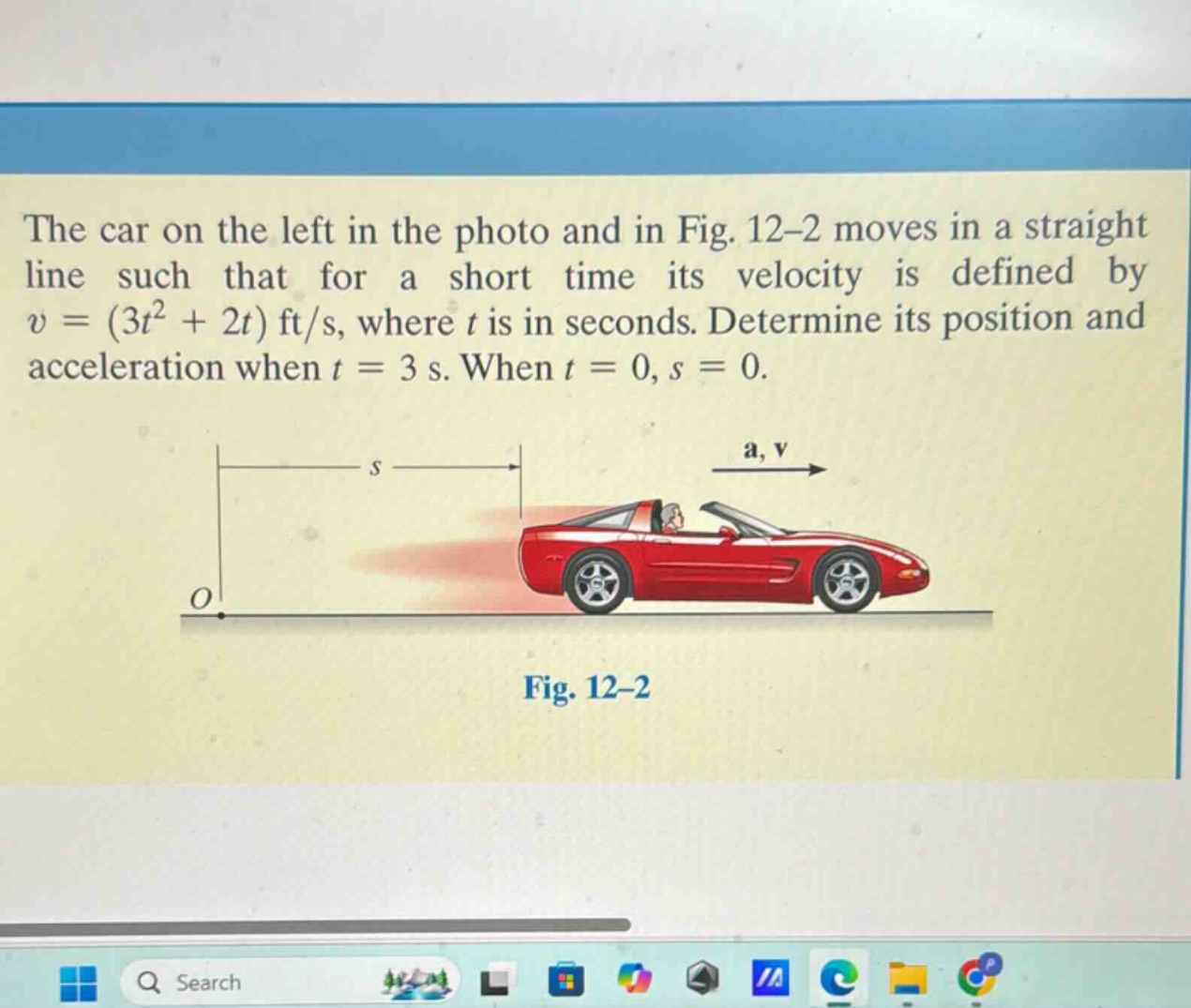
the car on the left in the photo and in fig. 12-2 moves in a straight line such that for a short time its velocity is defined by v = (3t² + 2t) ft/s, where t is in seconds. determine its position and acceleration when t = 3 s. when t = 0, s = 0.
Answer
Explanation:
Step1: Find position - Integrate velocity
We know that $v=\frac{ds}{dt}=(3t^{2}+2t)$. Integrating with respect to $t$ gives $s=\int(3t^{2}+2t)dt=t^{3}+t^{2}+C$. Since $s = 0$ when $t = 0$, $C = 0$. So $s=t^{3}+t^{2}$.
Step2: Calculate position at $t = 3$ s
Substitute $t = 3$ into the position formula: $s=(3)^{3}+(3)^{2}=27 + 9=36$ ft.
Step3: Find acceleration - Differentiate velocity
Acceleration $a=\frac{dv}{dt}$. Differentiating $v = 3t^{2}+2t$ with respect to $t$ gives $a = 6t+2$.
Step4: Calculate acceleration at $t = 3$ s
Substitute $t = 3$ into the acceleration formula: $a=6\times3+2=18 + 2=20$ ft/s².
Answer:
Position at $t = 3$ s is $36$ ft, acceleration at $t = 3$ s is $20$ ft/s².