a car makes sound as it moves toward a stationary observer. what best describes the sound wave heard by the…
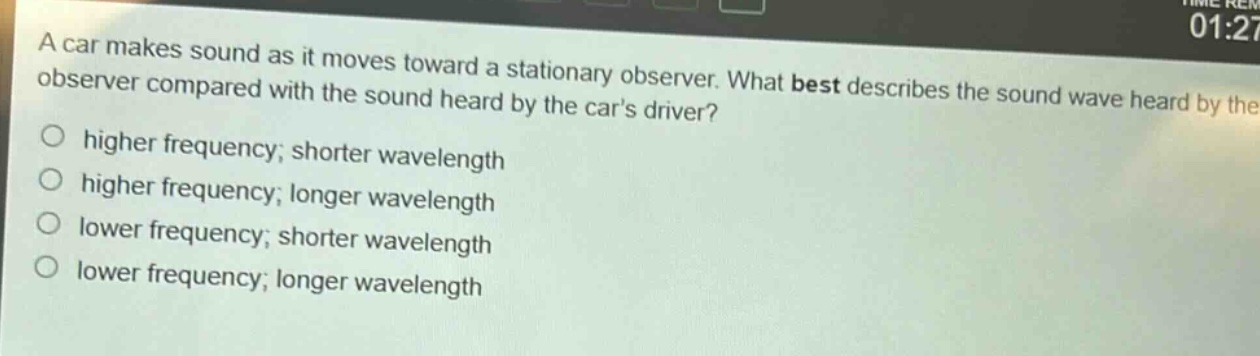
a car makes sound as it moves toward a stationary observer. what best describes the sound wave heard by the observer compared with the sound heard by the cars driver?\nhigher frequency; shorter wavelength\nhigher frequency; longer wavelength\nlower frequency; shorter wavelength\nlower frequency; longer wavelength
Answer
Answer:
A. higher frequency; shorter wavelength
Explanation:
Step1: Doppler - effect concept
The Doppler - effect occurs when a source of sound (the car) moves relative to an observer. When the source moves towards a stationary observer, the sound waves get compressed.
Step2: Frequency and wavelength relationship
The frequency $f$ and wavelength $\lambda$ of a wave are related by $v = f\lambda$, where $v$ is the speed of sound (constant in a given medium). When the waves are compressed (source moving towards observer), the wavelength $\lambda$ decreases. Since $v$ is constant, from $v = f\lambda$, when $\lambda$ decreases, the frequency $f$ increases. So the observer hears a higher - frequency sound with a shorter wavelength compared to the sound heard by the car's driver.