a car is starting to pull a camper up a hill. the car exerts an applied force of 2,100 n on the camper. the…
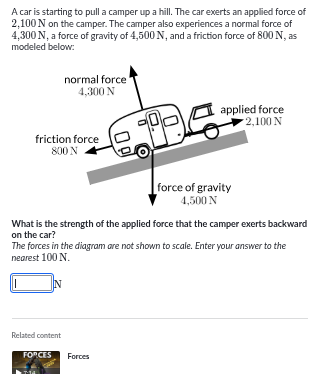
a car is starting to pull a camper up a hill. the car exerts an applied force of 2,100 n on the camper. the camper also experiences a normal force of 4,300 n, a force of gravity of 4,500 n, and a friction force of 800 n, as modeled below:normal force 4,300 napplied force 2,100 nfriction force 800 nforce of gravity 4,500 nwhat is the strength of the applied force that the camper exerts backward on the car?the forces in the diagram are not shown to scale. enter your answer to the nearest 100 n.______ n
Answer
Explanation:
Step1: Identify equilibrium condition
Since the camper is not accelerating along the hill, the sum of forces parallel to the hill is zero.
Step2: Set up force balance equation
Let $F_{backward}$ be the backward applied force from the camper. The forward applied force from the car balances the sum of the backward friction and the parallel component of gravity. First, find the parallel component of gravity: $$F_{gravity\parallel} = 4500,\text{N} - \text{vertical component, but we use horizontal equilibrium: } 2100 = F_{backward} + 800$$
Step3: Solve for backward force
Rearrange to isolate $F_{backward}$: $$F_{backward} = 2100 - 800$$ $$F_{backward} = 1300,\text{N}$$
Answer:
1300