carbon - 14 has a half - life of approximately 5,730 years. this exponential decay can be modeled with the…
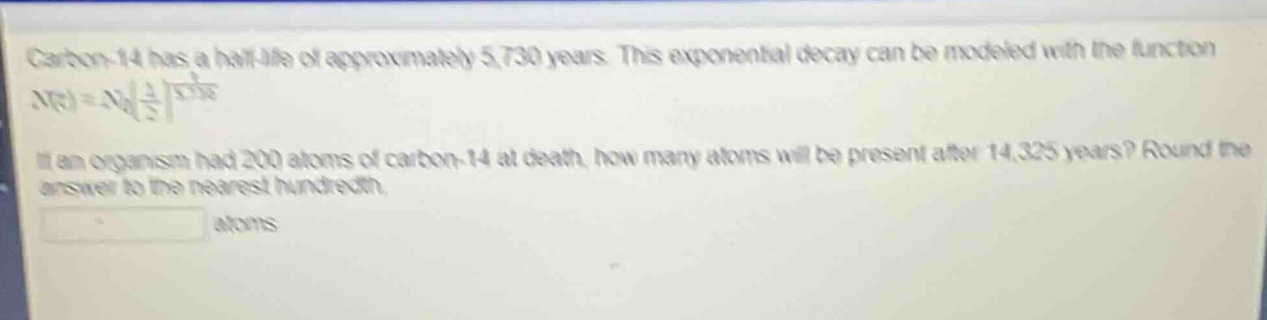
carbon - 14 has a half - life of approximately 5,730 years. this exponential decay can be modeled with the function $n(t)=n_0(\frac{1}{2})^{\frac{t}{5730}}$. if an organism had 200 atoms of carbon - 14 at death, how many atoms will be present after 14,325 years? round the answer to the nearest hundredth. atoms
Answer
Explanation:
Step1: Identify the values
$N_0 = 200$ (initial amount), $t = 14325$ (time passed), $h=5730$ (half - life).
Step2: Substitute into the formula
$N(t)=N_0\left(\frac{1}{2}\right)^{\frac{t}{h}}$, so $N(14325)=200\left(\frac{1}{2}\right)^{\frac{14325}{5730}}$.
Step3: Calculate the exponent
$\frac{14325}{5730}=2.5$.
Step4: Calculate the value of the power
$\left(\frac{1}{2}\right)^{2.5}=\frac{1}{2^{2.5}}=\frac{1}{\sqrt{2^5}}=\frac{1}{\sqrt{32}}\approx\frac{1}{5.656854}$.
Step5: Calculate the final amount
$N(14325)=200\times\frac{1}{5.656854}\approx 35.35$.
Answer:
$35.35$