carbon - 14 is used to determine the time an organism was living. the amount of carbon - 14 an organism has…
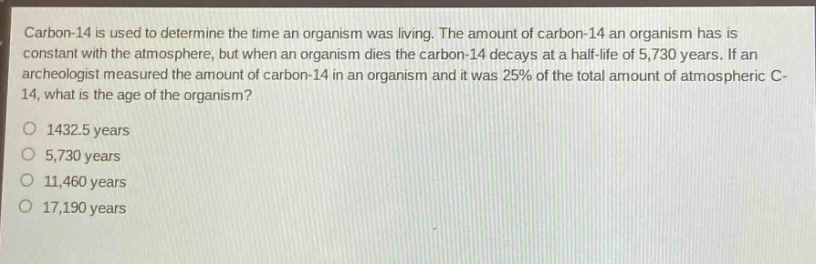
carbon - 14 is used to determine the time an organism was living. the amount of carbon - 14 an organism has is constant with the atmosphere, but when an organism dies the carbon - 14 decays at a half - life of 5,730 years. if an archeologist measured the amount of carbon - 14 in an organism and it was 25% of the total amount of atmospheric c - 14, what is the age of the organism?\no 1432.5 years\no 5,730 years\no 11,460 years\no 17,190 years
Answer
Answer:
C. 11,460 years
Explanation:
Step1: Understand half - life concept
The half - life formula for radioactive decay is $N = N_0(\frac{1}{2})^{\frac{t}{T_{1/2}}}$, where $N$ is the final amount, $N_0$ is the initial amount, $t$ is the time elapsed, and $T_{1/2}$ is the half - life.
Step2: Set up the values
We know that $N = 0.25N_0$ (since the amount of carbon - 14 is 25% of the initial amount) and $T_{1/2}=5730$ years. Substituting into the formula: $0.25N_0=N_0(\frac{1}{2})^{\frac{t}{5730}}$.
Step3: Solve for $t$
Divide both sides by $N_0$ (since $N_0\neq0$), we get $0.25 = (\frac{1}{2})^{\frac{t}{5730}}$. Since $0.25=\frac{1}{4}=(\frac{1}{2})^2$, then $\frac{t}{5730}=2$.
Step4: Calculate $t$
Multiply both sides by 5730, so $t = 2\times5730=11460$ years.