carla sees an equation that models a nuclear change. (_{1}^{2}h + _{1}^{3}h\rightarrow_{2}^{4}he+_{0}^{1}n)…
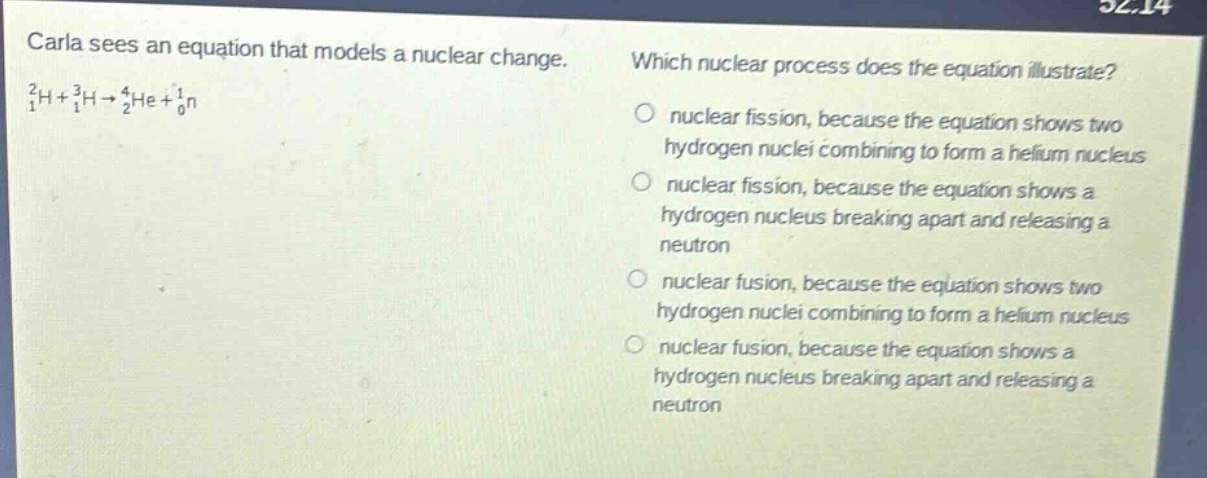
carla sees an equation that models a nuclear change. (_{1}^{2}h + _{1}^{3}h\rightarrow_{2}^{4}he+_{0}^{1}n) which nuclear process does the equation illustrate? nuclear fission, because the equation shows two hydrogen nuclei combining to form a helium nucleus nuclear fission, because the equation shows a hydrogen nucleus breaking apart and releasing a neutron nuclear fusion, because the equation shows two hydrogen nuclei combining to form a helium nucleus nuclear fusion, because the equation shows a hydrogen nucleus breaking apart and releasing a neutron
Answer
Explanation:
Step1: Recall nuclear process definitions
Nuclear fission is the splitting of a large nucleus into smaller ones. Nuclear fusion is the combination of smaller nuclei to form a larger one.
Step2: Analyze the given equation
The equation $_{1}^{2}H + _{1}^{3}H\rightarrow _{2}^{4}He+ _{0}^{1}n$ shows two hydrogen ($H$) nuclei combining to form a helium ($He$) nucleus. This is characteristic of nuclear fusion.
Answer:
nuclear fusion, because the equation shows two hydrogen nuclei combining to form a helium nucleus