carlos arranges his notes about radioactive decay in a graphic organizer. he wants to add the labels shown…
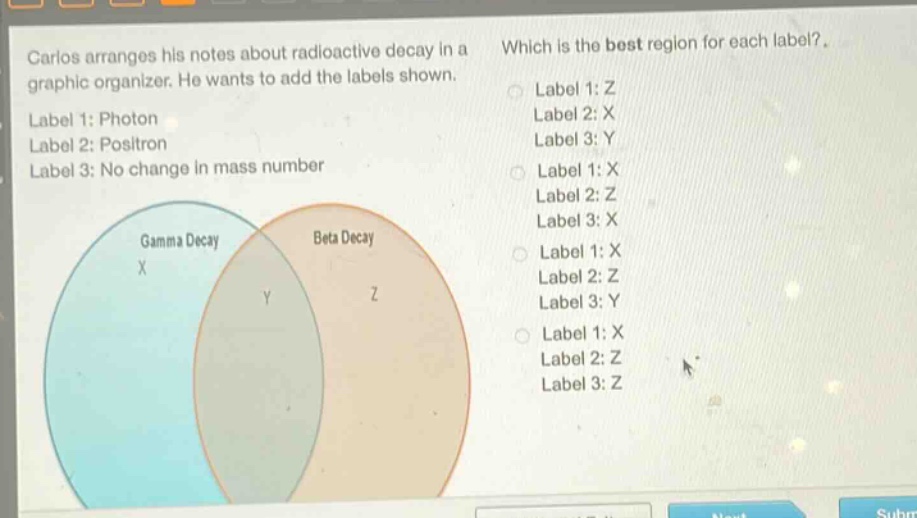
carlos arranges his notes about radioactive decay in a graphic organizer. he wants to add the labels shown. label 1: photon label 2: positron label 3: no change in mass number which is the best region for each label? label 1: z label 2: x label 3: y label 1: x label 2: z label 3: x label 1: x label 2: z label 3: y label 1: x label 2: z label 3: z gamma decay x beta decay y z
Answer
Explanation:
Step1: Recall gamma - decay properties
Gamma decay involves the emission of a photon. Gamma decay occurs when a nucleus is in an excited state and transitions to a lower - energy state by emitting a gamma ray (photon). So, the photon is associated with gamma decay, which is region X.
Step2: Recall beta - decay properties
Beta - plus decay involves the emission of a positron. Beta decay is represented by region Z.
Step3: Recall decay and mass - number relationship
In both gamma and beta decay, there is no change in the mass number. Gamma decay just releases energy in the form of a photon without changing the number of protons or neutrons. In beta - plus decay, a proton changes to a neutron and a positron is emitted, but the sum of protons and neutrons (mass number) remains the same. The overlapping region Y represents the property that is common to both gamma and beta decay, which is no change in mass number.
Answer:
Label 1: X Label 2: Z Label 3: Y