which change will always result in an increase in the gravitational force between two objects?\no increasing…
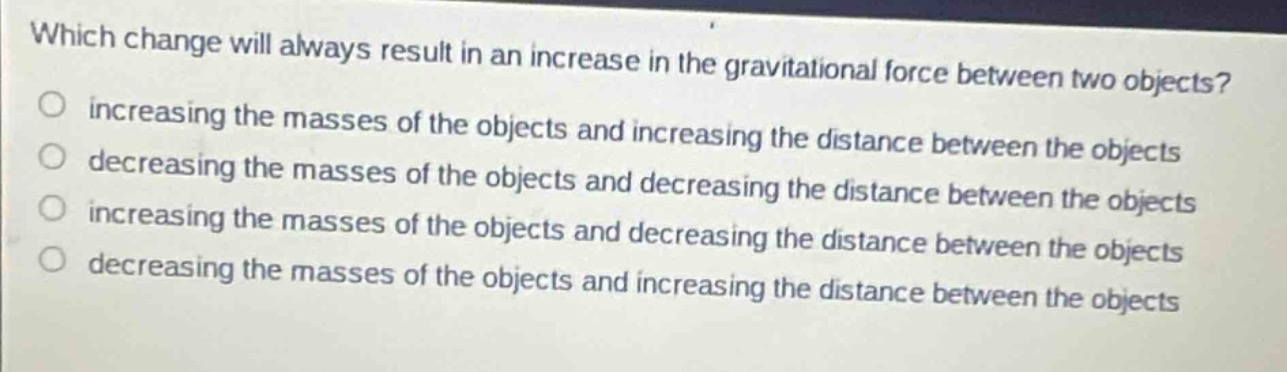
which change will always result in an increase in the gravitational force between two objects?\no increasing the masses of the objects and increasing the distance between the objects\no decreasing the masses of the objects and decreasing the distance between the objects\no increasing the masses of the objects and decreasing the distance between the objects\no decreasing the masses of the objects and increasing the distance between the objects
Answer
Explanation:
Step1: Recall gravitational - force formula
The gravitational force formula is $F = G\frac{m_1m_2}{r^2}$, where $F$ is the gravitational force, $G$ is the gravitational constant, $m_1$ and $m_2$ are the masses of the two objects, and $r$ is the distance between them.
Step2: Analyze the effect of mass and distance on force
From the formula, $F$ is directly proportional to $m_1$ and $m_2$ (if $m_1$ or $m_2$ increases, $F$ increases), and $F$ is inversely proportional to $r^2$ (if $r$ decreases, $F$ increases). So, increasing the masses of the objects and decreasing the distance between the objects will always increase the gravitational force.
Answer:
increasing the masses of the objects and decreasing the distance between the objects