when a charge moves between two points that have a potential difference of +12.0 v, its electric potential…
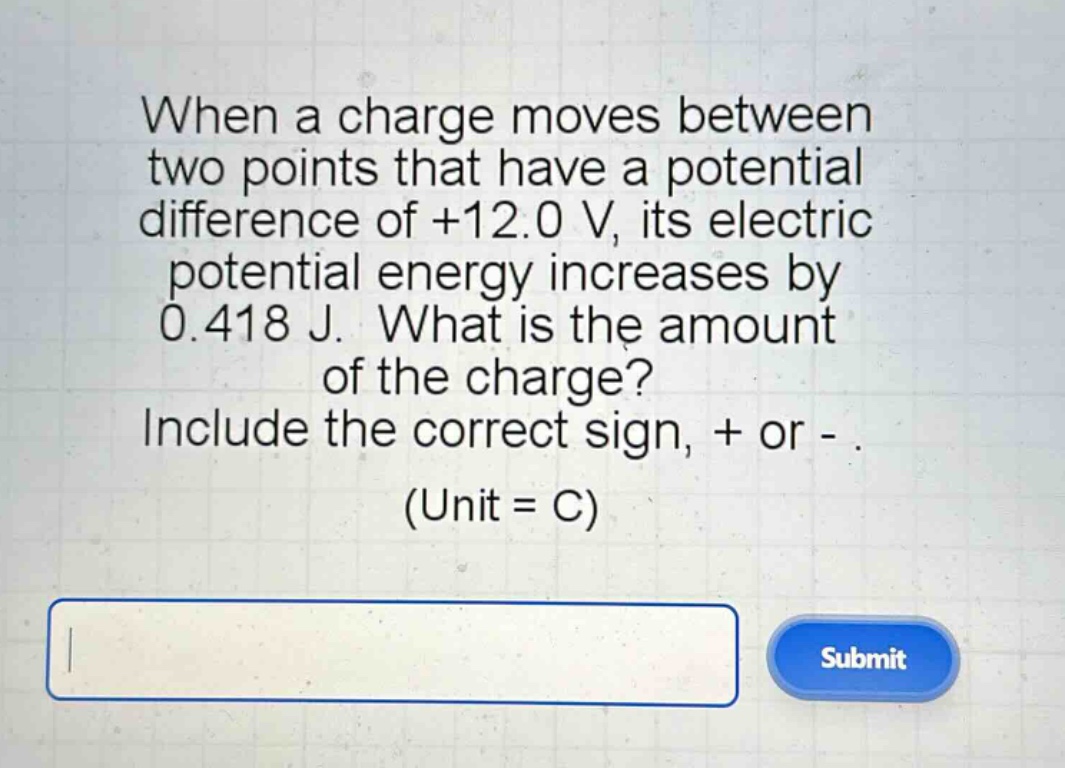
when a charge moves between two points that have a potential difference of +12.0 v, its electric potential energy increases by 0.418 j. what is the amount of the charge? include the correct sign, + or - . (unit = c)
Answer
Explanation:
Step1: Recall the formula
The relationship between electric - potential energy change ($\Delta U$), charge ($q$), and potential difference ($\Delta V$) is $\Delta U = q\Delta V$.
Step2: Solve for the charge
We can re - arrange the formula to $q=\frac{\Delta U}{\Delta V}$. Given $\Delta U = 0.418\ J$ and $\Delta V=12.0\ V$. $q=\frac{0.418}{12.0}\ C\approx0.0348\ C$. Since the electric potential energy increases, the charge must be positive because a positive charge moves from a lower potential to a higher potential when its potential energy increases.
Answer:
$+ 0.0348\ C$