how do the charges compare when two objects are charged through friction? the objects become oppositely…
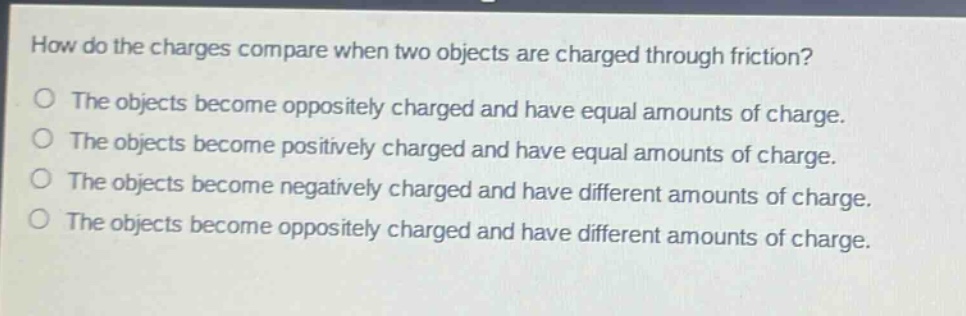
how do the charges compare when two objects are charged through friction? the objects become oppositely charged and have equal amounts of charge. the objects become positively charged and have equal amounts of charge. the objects become negatively charged and have different amounts of charge. the objects become oppositely charged and have different amounts of charge.
Answer
Brief Explanations:
When two objects are charged by friction, electrons are transferred from one object to the other. The law of conservation of charge states that the total charge in an isolated system remains constant. So, one object gains electrons (becomes negatively - charged) and the other loses the same number of electrons (becomes positively - charged), resulting in equal amounts of opposite charge.
Answer:
The objects become oppositely charged and have equal amounts of charge.