charges of +3 μc and -5 μc are 2 mm from each other. the -5 μc charge is replaced with a +5 μc charge. how…
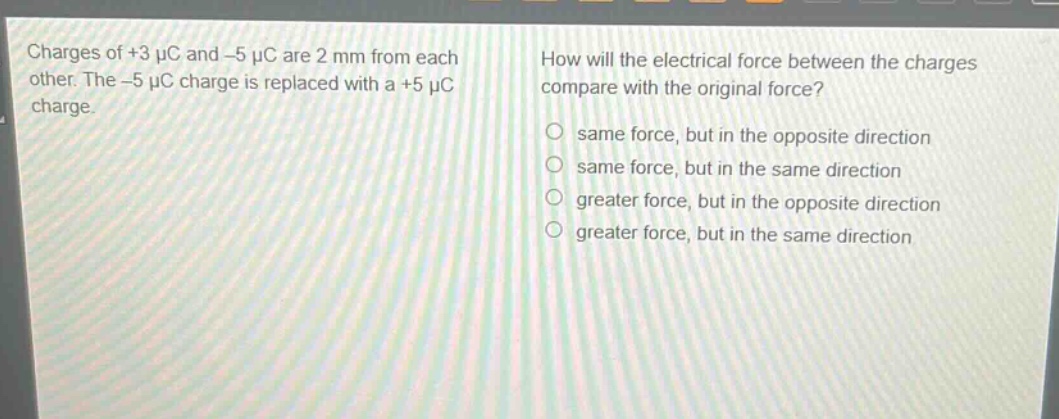
charges of +3 μc and -5 μc are 2 mm from each other. the -5 μc charge is replaced with a +5 μc charge. how will the electrical force between the charges compare with the original force? same force, but in the opposite direction same force, but in the same direction greater force, but in the opposite direction greater force, but in the same direction
Answer
Explanation:
Step1: Recall Coulomb's law
The electrical force between two charges is given by $F = k\frac{q_1q_2}{r^2}$, where $k$ is Coulomb's constant, $q_1$ and $q_2$ are the charges, and $r$ is the distance between them.
Step2: Analyze the original situation
Let $q_1 = + 3\ \mu C=3\times10^{- 6}\ C$, $q_2=-5\ \mu C = - 5\times10^{-6}\ C$, and $r = 2\ mm=2\times10^{-3}\ m$. The force $F_1=k\frac{q_1q_2}{r^2}=k\frac{(3\times10^{-6})\times(-5\times10^{-6})}{(2\times10^{-3})^2}$, and the negative sign indicates the nature of the force (attractive).
Step3: Analyze the new - situation
When $q_2$ is replaced with $+5\ \mu C = + 5\times10^{-6}\ C$, the new force $F_2=k\frac{q_1q_2}{r^2}=k\frac{(3\times10^{-6})\times(5\times10^{-6})}{(2\times10^{-3})^2}$.
Step4: Compare the magnitudes and directions
The magnitudes of $F_1$ and $F_2$ are equal since $|F_1|=|F_2| = k\frac{|3\times10^{-6}|\times|5\times10^{-6}|}{(2\times10^{-3})^2}$. The original force was attractive (opposite - sign charges), and the new force is repulsive (same - sign charges), so the force has the same magnitude but opposite direction.
Answer:
same force, but in the opposite direction