the chart lists the masses of four balls that have the same momentum. which correctly compares two of the…
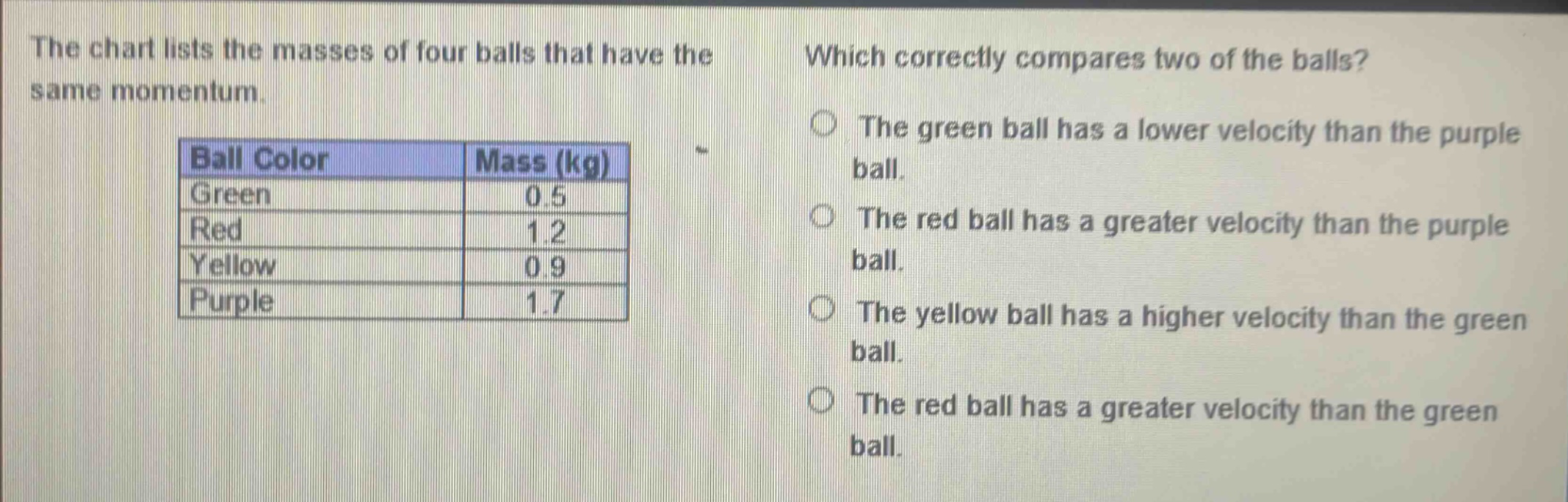
the chart lists the masses of four balls that have the same momentum. which correctly compares two of the balls? ball color mass (kg) green 0.5 red 1.2 yellow 0.9 purple 1.7 the green ball has a lower velocity than the purple ball. the red ball has a greater velocity than the purple ball. the yellow ball has a higher velocity than the green ball. the red ball has a greater velocity than the green ball.
Answer
Explanation:
Step1: Recall momentum formula
Momentum (p = mv), where (p) is momentum, (m) is mass and (v) is velocity. Given (p) is the same for all balls, then (v=\frac{p}{m}), so velocity is inversely - proportional to mass.
Step2: Analyze each option
- Option 1: Green ball mass (m_{green}=0.5) kg, purple ball mass (m_{purple}=1.7) kg. Since (m_{green}<m_{purple}), from (v = \frac{p}{m}), (v_{green}>v_{purple}), so this option is wrong.
- Option 2: Red ball mass (m_{red}=1.2) kg, purple ball mass (m_{purple}=1.7) kg. Since (m_{red}<m_{purple}), from (v=\frac{p}{m}), (v_{red}>v_{purple}), this option is correct.
- Option 3: Yellow ball mass (m_{yellow}=0.9) kg, green ball mass (m_{green}=0.5) kg. Since (m_{yellow}>m_{green}), from (v=\frac{p}{m}), (v_{yellow}<v_{green}), so this option is wrong.
- Option 4: Red ball mass (m_{red}=1.2) kg, green ball mass (m_{green}=0.5) kg. Since (m_{red}>m_{green}), from (v=\frac{p}{m}), (v_{red}<v_{green}), so this option is wrong.