the chart show the masses and velocities of two colliding objects that stick together after a collision…
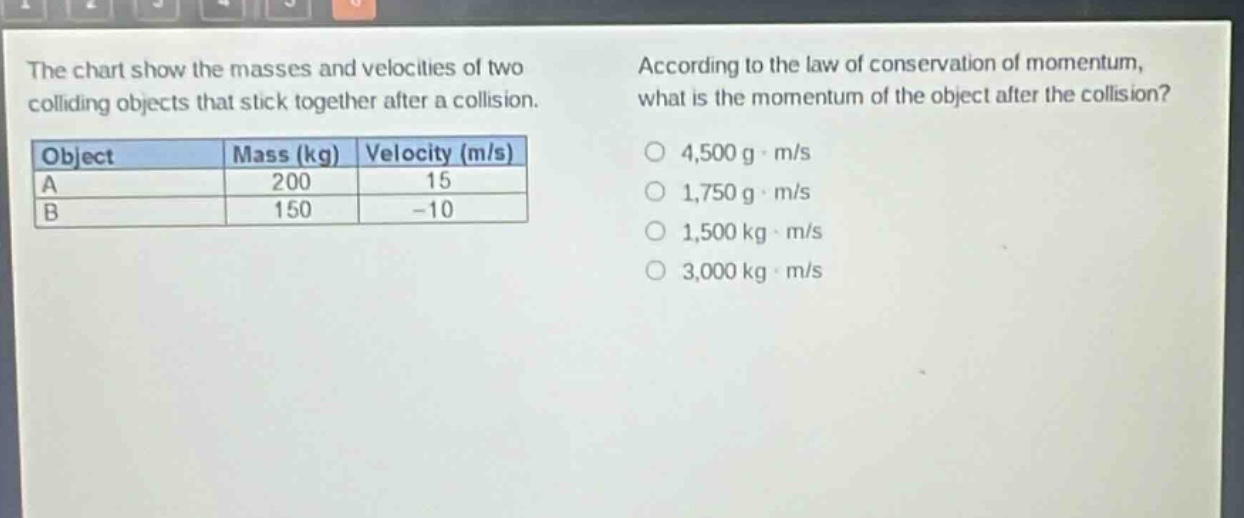
the chart show the masses and velocities of two colliding objects that stick together after a collision. according to the law of conservation of momentum, what is the momentum of the object after the collision?\n|object|mass (kg)|velocity (m/s)|\n|----|----|----|\n|a|200|15|\n|b|150|-10|\no 4,500 g·m/s\no 1,750 g·m/s\no 1,500 kg·m/s\no 3,000 kg·m/s
Answer
Explanation:
Step1: Calculate initial momentum of object A
The formula for momentum is $p = mv$. For object A, $m_A=200$ kg and $v_A = 15$ m/s. So $p_A=m_Av_A=200\times15 = 3000$ kg·m/s.
Step2: Calculate initial momentum of object B
For object B, $m_B = 150$ kg and $v_B=- 10$ m/s. So $p_B=m_Bv_B=150\times(-10)=-1500$ kg·m/s.
Step3: Calculate total initial momentum
According to the law of conservation of momentum, the total initial momentum $p_{total}=p_A + p_B$. So $p_{total}=3000+( - 1500)=1500$ kg·m/s. The momentum after the collision is equal to the total initial momentum since the objects stick - together.
Answer:
1,500 kg·m/s