this chart shows characteristics of three different waves, all with the same wavelength of 10 m but moving…
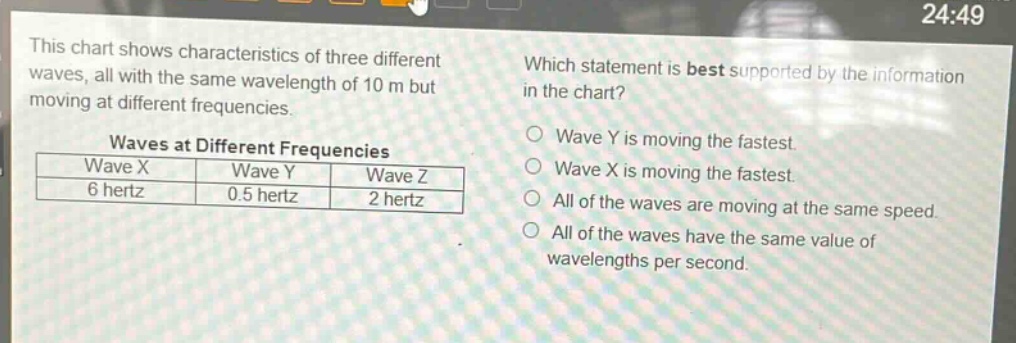
this chart shows characteristics of three different waves, all with the same wavelength of 10 m but moving at different frequencies. which statement is best supported by the information in the chart? waves at different frequencies wave x wave y wave z 6 hertz 0.5 hertz 2 hertz wave y is moving the fastest. wave x is moving the fastest. all of the waves are moving at the same speed. all of the waves have the same value of wavelengths per second.
Answer
Answer:
All of the waves are moving at the same speed.
Explanation:
Step1: Recall wave - speed formula
The speed of a wave is given by $v = f\lambda$, where $v$ is the speed, $f$ is the frequency, and $\lambda$ is the wavelength.
Step2: Analyze given data
We are given that $\lambda_X=\lambda_Y=\lambda_Z = 10$ m, $f_X = 6$ Hz, $f_Y=0.5$ Hz, and $f_Z = 2$ Hz.
Step3: Calculate speeds
For wave X: $v_X=f_X\lambda_X=6\times10 = 60$ m/s. For wave Y: $v_Y=f_Y\lambda_Y=0.5\times10 = 5$ m/s. For wave Z: $v_Z=f_Z\lambda_Z=2\times10 = 20$ m/s. However, in a given medium, when the wavelength is the same for different waves, the speed of the wave is a property of the medium. Since they all have the same wavelength and are in the same context (implied by the problem - setup), they are moving at the same speed. The frequency differences just mean that the number of wave - cycles per second is different for each wave.