the chart shows specific heat data for four substances. which conclusion is best supported by the data…
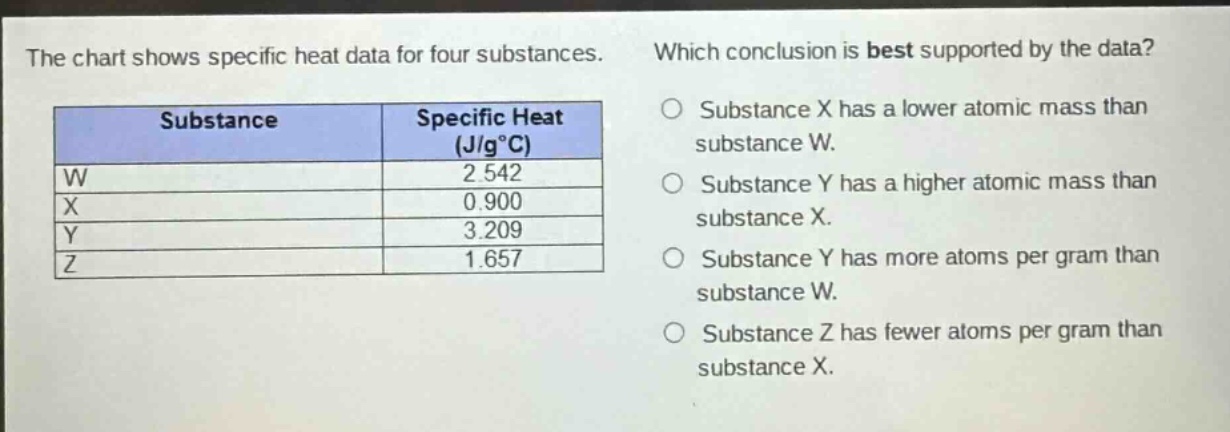
the chart shows specific heat data for four substances. which conclusion is best supported by the data? substance specific heat (j/g°c) w 2.542 x 0.900 y 3.209 z 1.657 substance x has a lower atomic mass than substance w. substance y has a higher atomic mass than substance x. substance y has more atoms per gram than substance w. substance z has fewer atoms per gram than substance x.
Answer
Explanation:
Step1: Recall the relationship between specific - heat and atomic mass/number of atoms
In general, substances with lower atomic mass or more atoms per gram tend to have higher specific heat values because more particles can store thermal energy.
Step2: Analyze each option
- Option 1: There is no direct way to infer atomic mass from specific - heat values alone just by comparing two substances like X and W.
- Option 2: Comparing X and Y, since Y has a higher specific heat than X, it is likely that Y has a lower atomic mass or more atoms per gram than X, which is consistent with the general relationship.
- Option 3: Comparing Y and W, Y has a higher specific heat than W, but we cannot directly say Y has more atoms per gram. There are other factors at play.
- Option 4: Comparing Z and X, Z has a higher specific heat than X, so it is more likely that Z has more atoms per gram or lower atomic mass than X, not fewer atoms per gram.