checkup\nfill in the blanks with the correct answers using words from the list.\ncarbonate change cleavage…
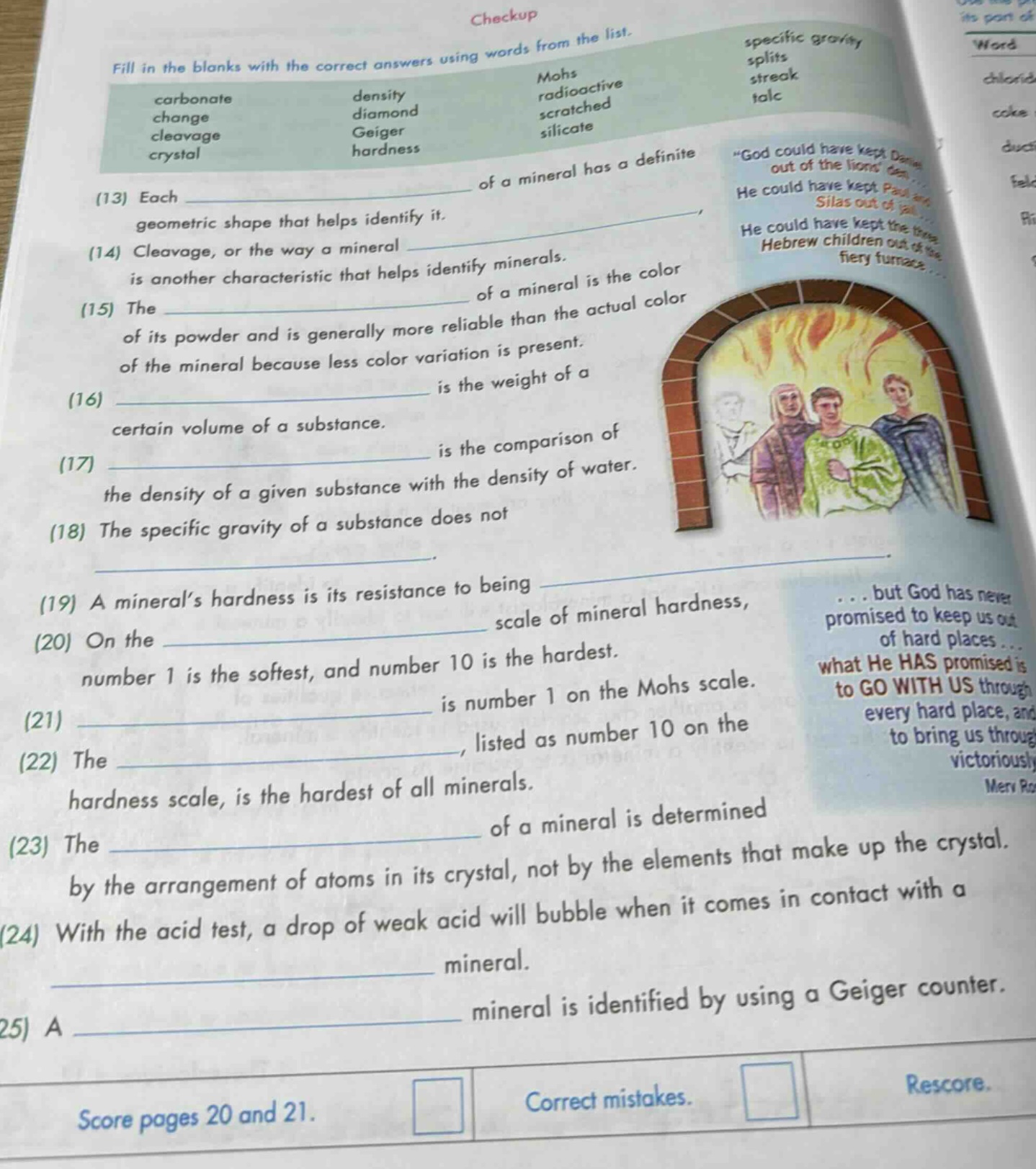
checkup\nfill in the blanks with the correct answers using words from the list.\ncarbonate change cleavage crystal density diamond geiger hardness mohs radioactive scratched silicate specific gravity splits streak talc\n(13) each ____ of a mineral has a definite geometric shape that helps identify it.\n(14) cleavage, or the way a mineral ____ is another characteristic that helps identify minerals.\n(15) the ____ of a mineral is the color of its powder and is generally more reliable than the actual color of the mineral because less color variation is present.\n(16) ____ is the weight of a certain volume of a substance.\n(17) ____ is the comparison of the density of a given substance with the density of water.\n(18) the specific gravity of a substance does not ____.\n(19) a mineral’s hardness is its resistance to being ____.\n(20) on the ____ scale of mineral hardness, number 1 is the softest, and number 10 is the hardest.\n(21) ____ is number 1 on the mohs scale.\n(22) the ____, listed as number 10 on the hardness scale, is the hardest of all minerals.\n(23) the ____ of a mineral is determined by the arrangement of atoms in its crystal, not by the elements that make up the crystal.\n(24) with the acid test, a drop of weak acid will bubble when it comes in contact with a ____ mineral.\n(25) a ____ mineral is identified by using a geiger counter.\nscore pages 20 and 21.\ncorrect mistakes.\nrescore.
Answer
Brief Explanations:
(13) Crystals of minerals have definite geometric shapes for identification. (14) Cleavage describes how a mineral splits. (15) Streak is the color of a mineral's powder, more reliable than its actual color. (16) Density is the weight of a certain volume of a substance. (17) Specific gravity is the comparison of a substance's density to water's density. (18) Specific gravity has no units. (19) Hardness is a mineral's resistance to being scratched. (20) The Mohs scale ranges from 1 (softest) to 10 (hardest). (21) Talc is number 1 on the Mohs scale. (22) Diamond is number 10 on the Mohs scale, the hardest mineral. (23) A mineral's crystal structure is determined by atom - arrangement in its crystal. (24) Carbonate minerals bubble with weak acid. (25) Radioactive minerals are identified with a Geiger counter.
Answer:
(13) crystal (14) splits (15) streak (16) density (17) specific gravity (18) have units (19) scratched (20) Mohs (21) talc (22) diamond (23) crystal structure (24) carbonate (25) radioactive